Travel Tips
Jeonju Bibimbap: What to Order and How to Plan a Food Trip from Seoul
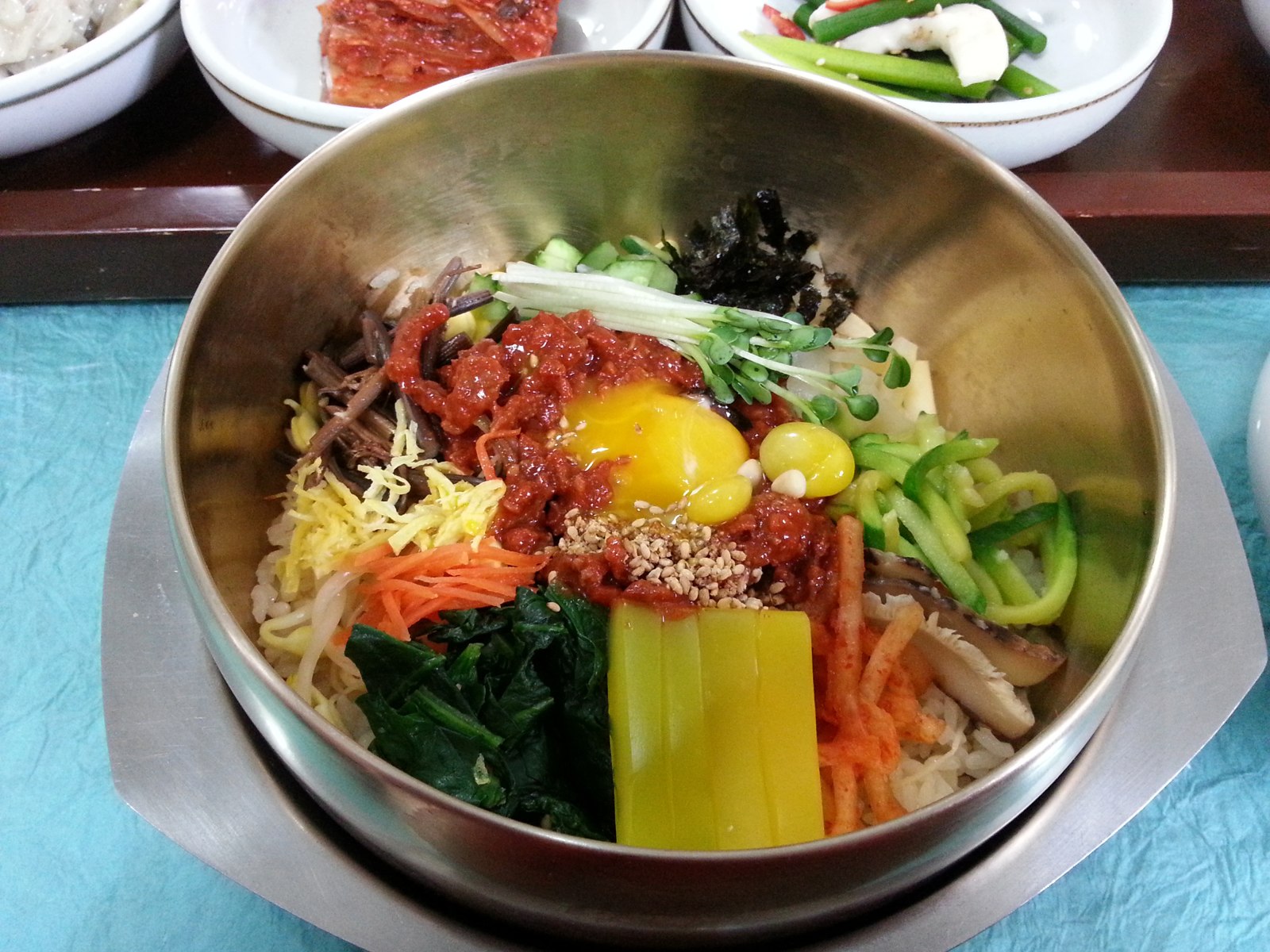
Cover photo: Bibimbap served in Jeonju. Photo: Douglas Paul Perkins, Wikimedia Commons, source, CC BY 3.0 (resized).

A bowl of mixed rice, a walk through the old town, and a market supper
Jeonju bibimbap (전주비빔밥) makes a good starting point for a food trip because the meal and the sightseeing fit together. Choose a bowl of rice, vegetables and beef near the old town, then spend the afternoon among Hanok Village’s tiled roofs, shrine grounds and market lanes.
The useful choices happen before you order: cooked beef or raw beef, a brass bowl or a hot stone bowl, and how much chili paste you want. This guide explains those choices, gives current price examples, and connects two long-running restaurants with Nambu Market and the nearby sights.
At a glance
Order: Jeonju bibimbap (전주비빔밥); choose cooked beef or yukhoe (raw beef)
Bowl budget: ₩14,000–₩18,000 at the two featured restaurants
Area: Central Jeonju, Hanok Village and Nambu Market
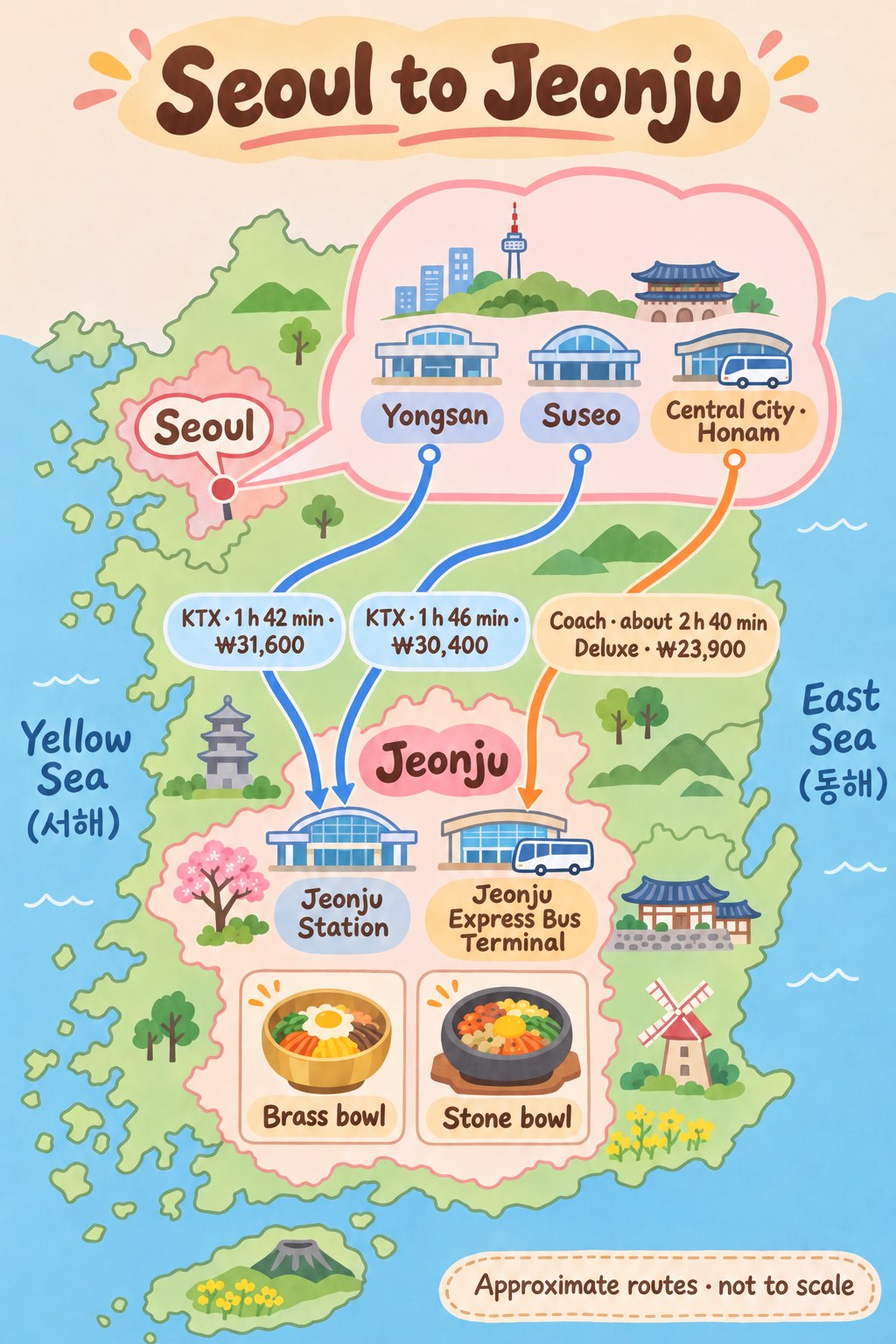
From Seoul: Yongsan KTX example about 1 h 40 min, ₩31,600; Central City coach about 2 h 40 min
Hours: Gajok Hoegwan 10:30–20:00 daily; Seongmidang 11:00–20:00, closed Monday, break 16:00–17:30
Market evening: Nambu night market Friday–Saturday 17:00–23:00
Last checked: November 27, 2026
In this guide
- What Makes Jeonju Bibimbap Different?
- How to Eat It
- How to Order: Korean Menu Names
- How Much to Budget
- Where to Eat
- Nambu Market: A Third Food Stop
- Getting There
- Nearby
- Where to Stay
- Tips for Foreign Visitors
- Sources
What Makes Jeonju Bibimbap Different?
Bibimbap means a mixed-rice meal. The neat arrangement is its starting point: rice underneath, separately prepared vegetables above, then beef, egg and seasoning. Mixing brings the ingredients together, so the finished meal looks very different from the bowl that first arrives.
In Jeonju, look for crisp bean sprouts and hwangpomuk (황포묵), a yellow mung-bean jelly colored with gardenia fruit. The rice may be cooked in beef-bone broth or bean-sprout broth. These details help explain why a bowl can taste savory before you have added much sauce.
There is room for variation. One restaurant’s vegetables, seasoning and presentation need not match another’s, and the ingredient list is more useful than an impressive ingredient count. Bean sprouts, spinach, bracken, bellflower root, mushrooms and zucchini are among the components you may encounter.
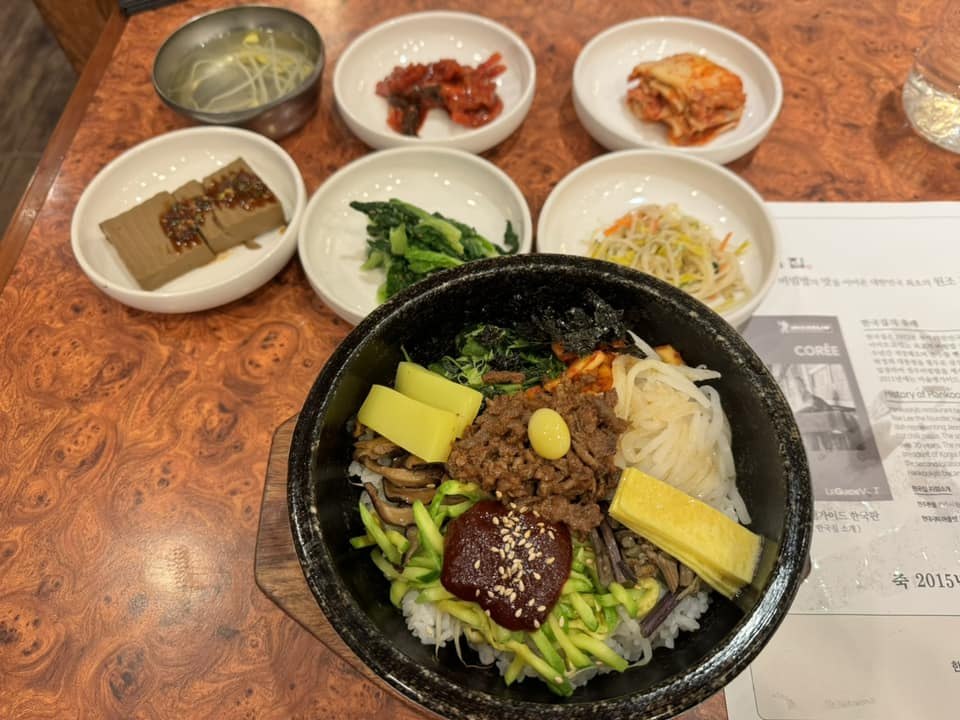
A food with market roots and a restaurant tradition
Jeonju bibimbap’s history includes market meals and the specialist restaurants that developed after Korea’s liberation. Han Kook Jib (한국집) opened in 1952 as a rice-cake shop and began serving bibimbap in 1953. Its later restaurant tradition helped shape the more elaborate meal associated with the city.
That history is a better reason to explore than a claim that one person invented every version. For your own visit, notice what the bowl and side dishes reveal: individually prepared ingredients, a serving vessel chosen for the dish, and a meal that extends beyond the rice itself.
Brass bowl or dolsot?
Yugi (유기) is traditional brassware; a brass bowl is a notgeureut (놋그릇). Dolsot (돌솥) means a stone pot. A Jeonju-style bibimbap does not automatically arrive in stone, so choose the version you want rather than assuming the city name describes the bowl.
For a first visit, the brass-bowl version lets you concentrate on the rice, toppings and sauce. Choose dolsot if the heated stone serving style appeals to you. Keep your hands away from the hot vessel; use its supporting tray rather than trying to reposition it by the rim.
How to Eat It
Look over the bowl before mixing. If the egg or beef is different from what you expected, ask while the components are still visible. This is also the moment to identify any separate chili paste rather than pouring it all in automatically.
- Mix through to the rice. Use your spoon to lift rice from the bottom and fold the vegetables, beef and egg into it. Chopsticks can help loosen and distribute the toppings.
- Taste before adding sauce. Gochujang (고추장) is chili paste, and some kitchens season or mix the rice before serving. Add a small amount at a time if more is offered.
- Eat the side dishes alongside it. Banchan (반찬) are the small dishes around the bowl. Try them between spoonfuls rather than emptying the entire table into the rice.
- Keep the soup as a companion. Take spoonfuls between bites. You can enjoy the rice mixture and soup separately without turning the bowl into a soup dish.
At Seongmidang, the rice is already mixed in a pan with bean sprouts, chili paste and sesame oil before the toppings are arranged in a brass bowl. Start by mixing that bowl again and tasting it. Extra gochujang may change the balance more quickly than you expect.
Tip
Order the beef style before discussing the sauce. “Less spicy” does not mean cooked beef, and asking for no raw beef does not remove a raw egg yolk. Show the Korean phrase that addresses the ingredient you actually want to change.
Kongnamul-guk and kongnamul-gukbap
The bean-sprout soup that accompanies a bibimbap meal is kongnamul-guk (콩나물국). Kongnamul-gukbap (콩나물국밥) is a separate main meal of soup and rice, another Jeonju specialty. The extra syllable bap means rice and matters when you read a menu.
If your aim is one bibimbap lunch, do not order a second soup-and-rice main merely to obtain the soup side. If you stay overnight, kongnamul-gukbap gives you a different food to try at another meal. Nambu Market is a useful area to include in that wider food walk.
How to Order: Korean Menu Names
Save the Hangul as well as the romanization. A menu photograph or a written Korean name is often easier to show than an unfamiliar English spelling. Start with the dish, specify the beef, then ask about sauce or egg if those matter to you.
| 전주비빔밥 Jeonju bibimbap | Jeonju-style mixed rice. Ask about the beef and egg rather than assuming their preparation. |
| 육회비빔밥 Yukhoe bibimbap | Bibimbap with seasoned raw beef. Choose cooked beef if you do not want raw meat. |
| 돌솥비빔밥 Dolsot bibimbap | Bibimbap served in a heated stone bowl. |
| 놋그릇 / 유기 Notgeureut / yugi | Brass bowl / traditional brassware; useful words when distinguishing the serving vessel. |
| 고추장 Gochujang | Chili paste. Ask for it separately before the kitchen mixes the rice. |
| 콩나물국 / 콩나물국밥 Kongnamul-guk / kongnamul-gukbap | Bean-sprout soup / a soup-and-rice main meal. |
| 반찬 Banchan | Small side dishes served around the main bowl. |
“Jeonju bibimbap han geureut juseyo” (전주비빔밥 한 그릇 주세요) means “One bowl of Jeonju bibimbap, please.” For cooked meat, show “Ikhin gogiro juseyo” (익힌 고기로 주세요). For sauce on the side, use “Gochujangeun ttaro juseyo” (고추장은 따로 주세요).
To ask for the raw beef to be removed, show “Yukhoe ppae juseyo” (육회 빼 주세요). Make the request before ordering is finalized. These are requests, and a kitchen may be unable to change a mixture that has already been prepared.
Good to know
A bowl covered in vegetables can still contain beef, beef-bone stock, sesame oil, soy sauce, nuts and egg. Removing visible meat alone does not establish that the meal meets a vegetarian diet or an allergy requirement. Describe all the ingredients you need to avoid before ordering.
For a group, decide whether everyone wants the same beef style. Pointing at one bowl and saying the number of people can leave the most important choice unstated. Ordering each type clearly is also helpful when some diners want raw beef and others prefer cooked meat.
How Much to Budget
Allow ₩14,000–₩18,000 per person for a bowl at the two restaurants below. This is a sample of named central Jeonju restaurants, rather than a minimum or maximum for the whole city. Raw-beef versions in this selection cost more than the ordinary bibimbap.
| Gajok Hoegwan | Jeonju bibimbap ₩14,000; yukhoe bibimbap ₩17,000. |
| Seongmidang | Jeonju bibimbap ₩16,000; yukhoe bibimbap ₩18,000. |
A pair ordering two ordinary bowls would spend ₩28,000 at Gajok Hoegwan or ₩32,000 at Seongmidang, before additional items. Two raw-beef bowls would be ₩34,000 or ₩36,000 respectively. That makes it easy to compare the meal itself without confusing it with a larger set menu.
Leave room in the budget for transport and any market snacks. If you want to taste something later, choose your bibimbap first and decide on extras after seeing the meal. A table of side dishes can make the lunch more substantial than the single-bowl description suggests.
Where to Eat
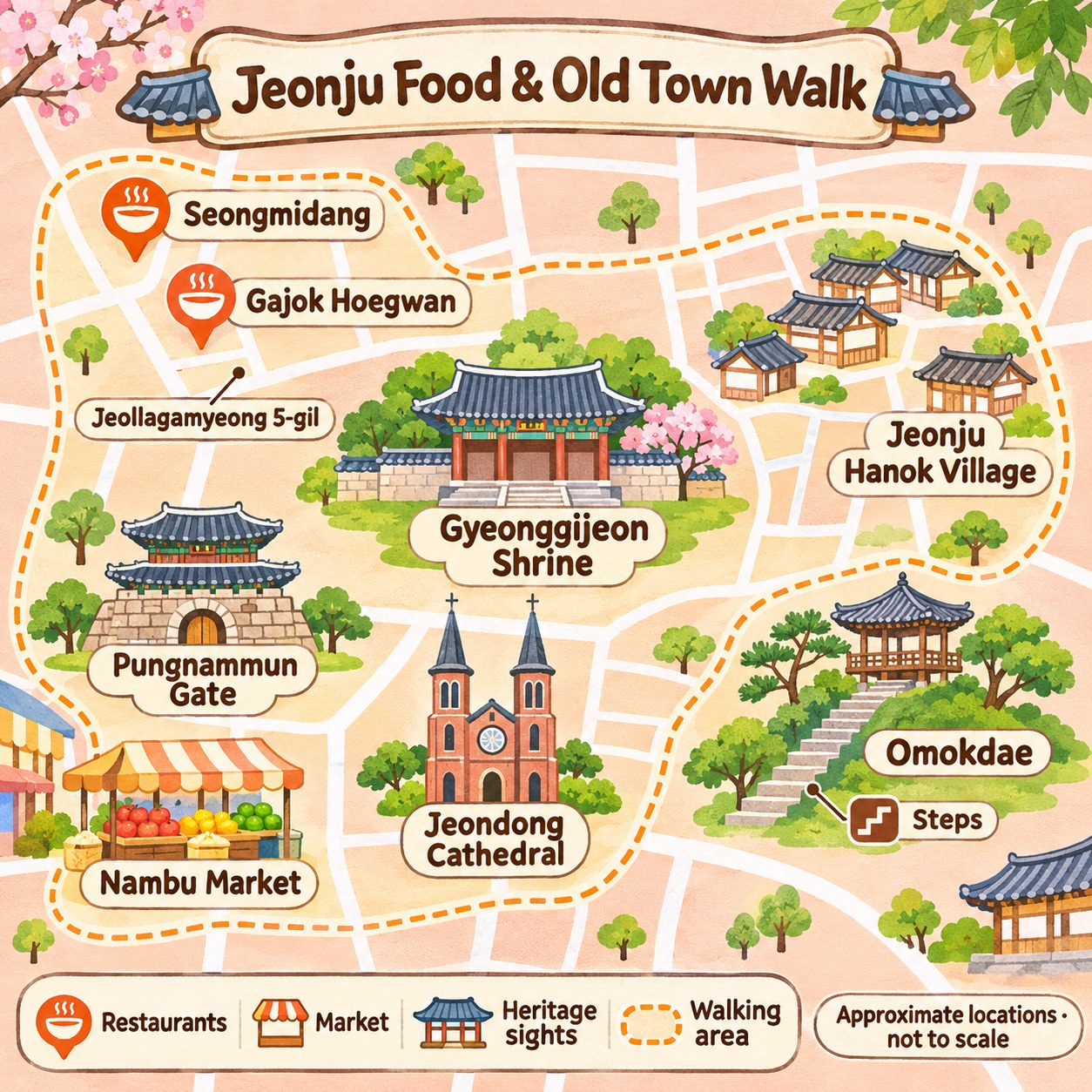
Gajok Hoegwan and Seongmidang are near the old town’s Jeollagamyeong and Gaeksa area, west of Hanok Village. Choose one for the main meal rather than rushing between full lunches. Their different preparation styles give you a useful reason to choose.
Gajok Hoegwan (가족회관), ‘a brass bowl with a generous table of sides’
The rice is cooked in beef-bone stock and served in brassware. The surrounding banchan and steamed egg make this a good choice if the whole table interests you as much as the rice bowl.
Type: Traditional Jeonju bibimbap restaurant
Signature dishes: Jeonju bibimbap (전주비빔밥) ₩14,000; yukhoe bibimbap (육회비빔밥) ₩17,000
Hours: Daily 10:30–20:00; open year-round
Tip for foreign visitors: The broth matters for dietary choices even when you remove a beef topping. Order the cooked or raw-beef version explicitly.
Getting there: On Jeollagamyeong 5-gil, west of Gyeonggijeon, in the Gaeksa/old-town restaurant area.
Address · phone: 17 Jeollagamyeong 5-gil, Wansan-gu, Jeonju · 063-284-0982
Visitor review (in Korean, use your browser’s translate): Self-paid bibimbap visit (대니얼11, April 2025)
Seongmidang (성미당), ‘rice seasoned before it reaches the table’
Established in 1965, this specialist mixes rice, bean sprouts, chili paste and sesame oil in a pan, then arranges the toppings in a brass bowl. It offers a useful contrast to a bowl whose seasoning is entirely left to the diner.
Type: Long-running Jeonju bibimbap restaurant
Signature dishes: Jeonju bibimbap (전주비빔밥) ₩16,000; yukhoe bibimbap (육회비빔밥) ₩18,000
Hours: 11:00–20:00; closed Monday; plan around the 16:00–17:30 break
Tip for foreign visitors: Taste the seasoned rice before adding extra chili paste. Requesting sauce on the side may not suit this preparation.
Getting there: In the Jeollagamyeong 5-gil lanes near Gaeksa; save the full street address for the final turn.
Address · phone: 19-9 Jeollagamyeong 5-gil, Wansan-gu, Jeonju · 063-287-8800
Visitor review (in Korean, use your browser’s translate): Visit review by 맛있는거만 먹을래 (January 25, 2025)
Use the full Korean name and street address when saving a destination. “Jeonju bibimbap” is a dish served at many businesses, and a familiar restaurant name may also appear at branches elsewhere in Korea. The addresses above identify the central Jeonju locations described here.
Nambu Market: A Third Food Stop
Nambu Market (남부시장, Nambu Sijang) gives the trip a different setting after the restaurant meal. It sits beside Pungnammun, the surviving southern gate, southwest of Hanok Village. Treat the market as somewhere to browse and choose food that catches your eye rather than as another compulsory bibimbap lunch.
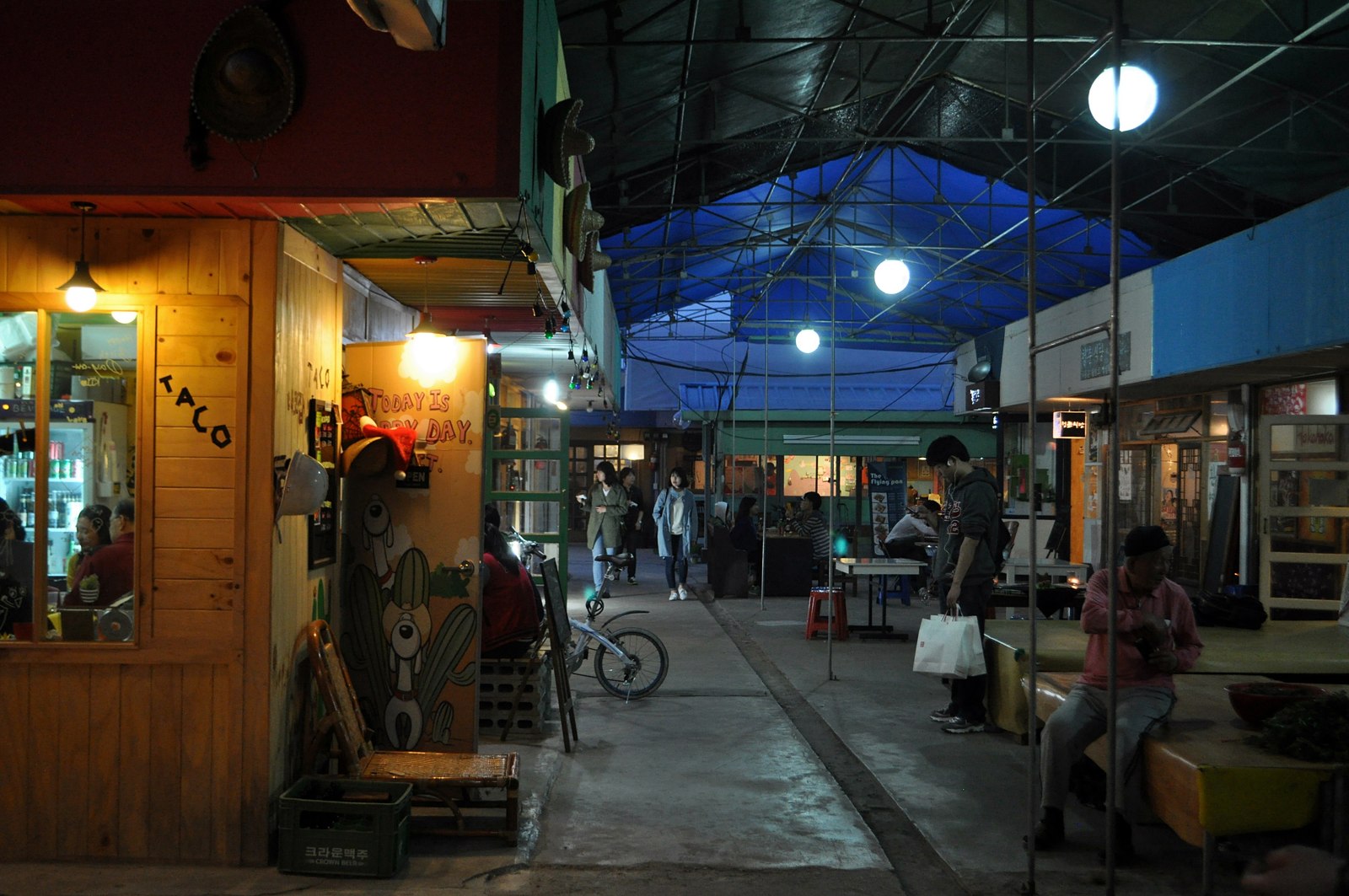
Nambu Market (남부시장), ‘save space for a market supper’
The night market turns the covered market lanes into a food stop on Friday and Saturday evenings. It fits naturally after a daytime walk through the village and shrine area.
Type: Traditional market and evening food stalls
Hours: Night market Friday–Saturday 17:00–23:00
Tip for foreign visitors: Make your main bibimbap meal earlier, then choose a smaller supper here. Daytime shops and night stalls have different offerings.
Getting there: From the village’s west side, head toward Pungnammun and into the market lanes.
Address · phone: 49 Pungnammun 2-gil, Wansan-gu, Jeonju · 063-288-1344
If the night market is a priority, staying Friday or Saturday night removes the need to hurry away just as the food stalls become the focus. On other days, plan a daytime market visit instead. The upstairs Youth Mall is a separate part of the market, so an upstairs photograph should not be taken as a guide to the evening food stalls.
Getting There
Book Jeonju Station (전주역) for the train, or Jeonju Express Bus Terminal (전주고속버스터미널) for the Central City coach. Neither arrival point is Hanok Village itself. Include the final local journey in your plan before choosing a restaurant arrival time.
| Yongsan → Jeonju KTX 509 | 09:53–11:33 · about 1 h 40 min · ordinary adult ₩31,600. |
| Suseo → Jeonju KTX 663 | 10:20–12:05 · about 1 h 45 min · ordinary adult ₩30,400. |
| Yongsan → Jeonju ITX-Maum 1511 | 09:47–12:51 · about 3 h 04 min · ordinary adult ₩26,200. |
| Central City → Jeonju Express coach | About 2 h 40 min. Regular ₩16,400; deluxe ₩23,900; premium ₩31,000. |
These rail examples use the official timetable effective November 1, 2026, with ordinary adult one-way fares. Minutes are shown as in a traveler timetable, without operational seconds. The ITX fare saves ₩5,400 against the listed Yongsan KTX fare, while the sample journey takes substantially longer.
For Saturday, November 28, the official bus timetable runs 05:30–24:00 from Central City to Jeonju and 05:00–24:00 from Jeonju to Central City. The final departure in each direction is midnight at the end of that service day. Late deluxe buses cost ₩28,600, compared with ₩23,900 for daytime deluxe.
In Seoul, the Jeonju service uses Central City’s Honam terminal in the Express Bus Terminal complex. Use that terminal name when collecting your ticket and finding the boarding area. In Jeonju, save the express-terminal name rather than substituting the separate intercity terminal.
Our pick
Take the Yongsan KTX if a shorter ride is your priority; the sample 09:53 departure reaches Jeonju at 11:33. For a weekend evening at Nambu Market, stay overnight so dinner does not depend on a tight station transfer.
From Jeonju Station or the express terminal
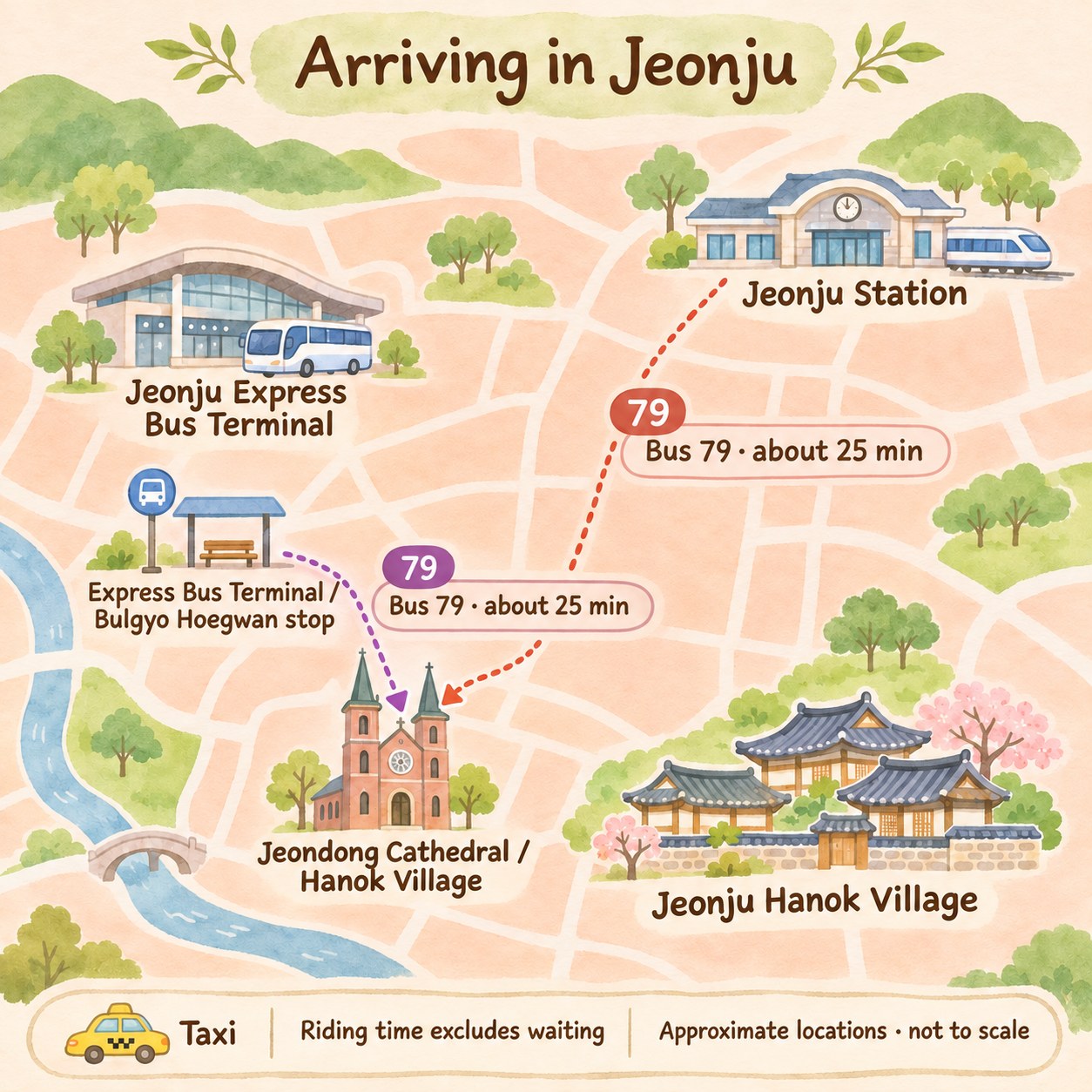
From Jeonju Station, city directions list bus 79 to the Jeondong Cathedral / Hanok Village stop (전동성당·한옥마을), with about 25 minutes riding time. Add time to find the stop and wait. Keep the Korean destination visible on your phone so you can distinguish the bus stop from the railway station.
From the express terminal, use the Express Bus Terminal / Bulgyo Hoegwan stop (고속버스터미널·불교회관); bus 79 reaches the same cathedral/village area in about 25 minutes. A taxi is an alternative if carrying luggage, and the Korean destination 전동성당 is useful for the village’s western side. Agree on the destination before setting off.
For a same-day return, one KTX option is Jeonju 19:28 → Yongsan 21:13. The timetable’s last Yongsan service leaves Jeonju at 23:11 and arrives at 00:44 the following day. Choose your return ticket with onward travel from Yongsan in mind, and allow a generous margin for the journey back to Jeonju Station.
Nearby
The old town works well as a sequence of walks around the meal. Start with the western sights, move through the village, and decide whether you want the hill climb before heading to the market. The order below is a planning suggestion rather than a timed tour.
Jeonju Hanok Village (전주한옥마을)
Give yourself time to leave the busiest route and look at the tiled roofs and lanes. The village contains cultural spaces as well as homes and businesses. Keep to public routes and enter courtyards only where visitors are invited; a handsome gate is not necessarily an attraction entrance.
As a planning allowance, leave an unhurried afternoon around your lunch rather than assigning every lane a fixed number of minutes. That gives you room for a cultural stop or a rest without having to turn the walk into a race between meals.
Gyeonggijeon Shrine (경기전)
Gyeonggijeon was established in 1410 to enshrine the portrait of King Taejo, the founder of Joseon. It adds historical context to the food walk and is a good principal sightseeing stop if you prefer one substantial visit to a long checklist.
In November–February the grounds open 09:00–18:00, with an ordinary adult ticket of ₩3,000. Spring and autumn hours are 09:00–19:00 in March–May and September–October, and summer hours are 09:00–20:00 in June–August. Plan a late-November visit during the afternoon before the market evening.
Jeondong Cathedral (전동성당)
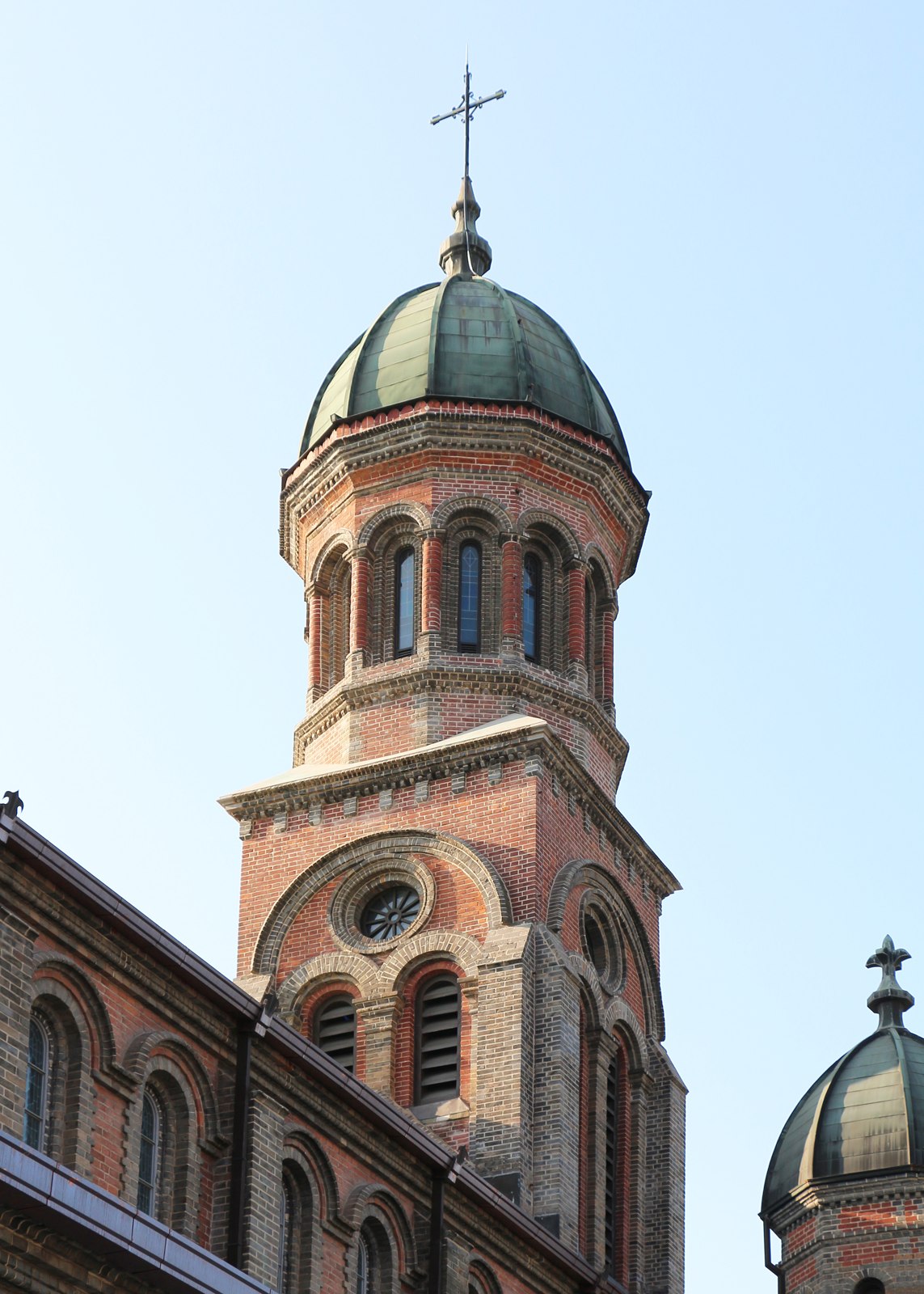
The brick church brings Romanesque and Byzantine architectural forms into the western edge of the village. Completed in 1914, it makes a useful landmark when arriving by local bus. Enjoy the exterior as part of your walk, and remember that it is a place of worship.
Omokdae (오목대)
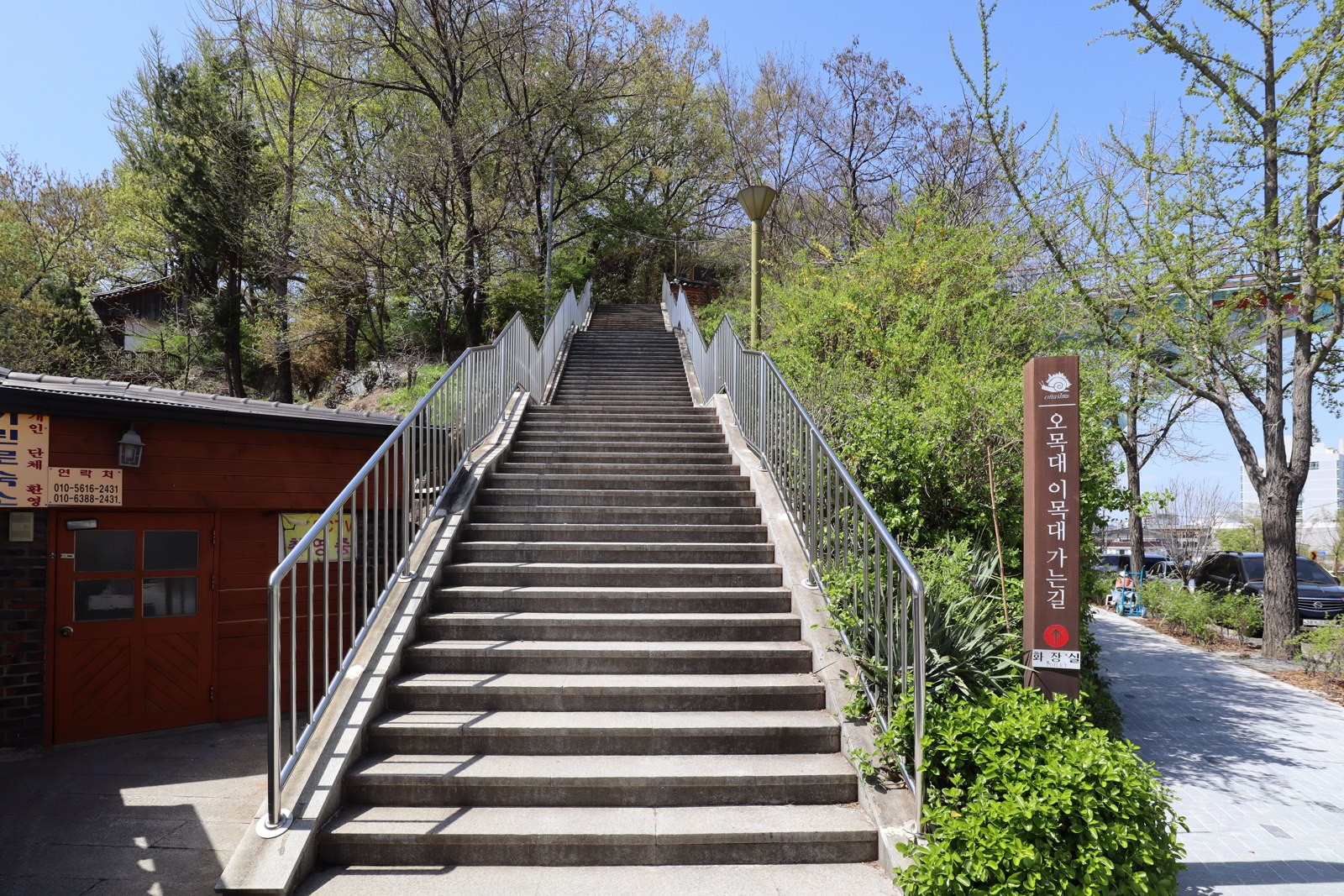
Omokdae is the hill pavilion associated with Yi Seong-gye’s victory banquet and views over the village roofs. Make the climb if you want a change from the lanes below. The approach includes steps, so it belongs on the optional part of the walk if stairs are difficult for your group.
Finish toward Pungnammun (풍남문) and Nambu Market if dinner is your next stop. Pungnammun’s exterior can be viewed year-round without an admission charge. This gives the afternoon a clear endpoint without adding another full meal booking.
Where to Stay
An overnight stay makes the most sense when you want to eat slowly at the Friday or Saturday night market. Pick the type of room first: a historic hanok experience or a modern hotel base. These three options have official information links; use the room description to choose the sleeping arrangement that suits you.
- Hagindang (학인당): a historic hanok offering accommodation and cultural experiences by reservation. A good starting point for travelers interested in the house itself. Official city accommodation listing.
- Lahan Hotel Jeonju (라한호텔 전주): a modern hotel at 85 Girin-daero on the village’s edge, useful if you prefer a hotel base near the walking area. Official location and hotel information.
- Jeonju Tourist Hotel Kkotsim (전주관광호텔 꽃심): a central boutique hotel at 171 Paldal-ro, convenient for a plan that includes the old town’s restaurant area. Official hotel introduction.
Tips for Foreign Visitors
Build the day around the meal you most want. Gajok Hoegwan and Seongmidang are alternatives for the main lunch, while Nambu Market offers a different evening setting. If a particular beef style matters more than the restaurant name, settle that choice first.
- Save the restaurant’s Hangul name, address and the menu item together. It makes ordering and navigation easier than switching between separate screenshots.
- Ask about ingredient changes before the order is finalized. A request for cooked beef, no raw yolk or separate sauce needs a clear response from the kitchen.
- Keep the station and the village as separate destinations in your return plan. Local-bus riding time does not include waiting or the walk to the platform.
- Give the market its own appetite budget. You do not need a second full bibimbap to make the trip feel complete.
- For late November, arrange the shrine and hill walk before settling into the market evening. Carry less during the walking part if you can leave your overnight bag at your accommodation.
Good to know
A satisfying Jeonju food trip can be simple: one carefully chosen bibimbap, a walk that includes a place you want to see, and enough time to enjoy the next meal. Keep the return journey comfortable rather than making the latest possible departure the target.
Sources
- Food and history: Korea Tourism Organization: Jeonju bibimbap
- Restaurant recipe and operations: Jeonbuk Food Culture: Gajok Hoegwan
- Restaurant preparation and operations: Jeonbuk Food Culture: Seongmidang
- Current Seongmidang menu: Menu listing, merchant revision November 22, 2025
- Independent menu cross-check: Diningcode: Seongmidang
- Night market: Visit Jeonju: night-tourism route
- Local connections: Jeonju Hanok Village: official directions
- Heritage sights: Jeonju Hanok Village: historic places
- KTX timetable: Korail timetable effective November 1, 2026
- KTX fares: Korail fares effective September 1, 2026
- ITX timetable: Korail general-train timetable effective November 1, 2026
- ITX fares: Korail general-train fares effective September 1, 2026
- Suseo services: SR: high-speed rail integration notice
- Coaches: KOBUS: Central City–Jeonju timetable and fares
Last checked: November 27, 2026. Bus first and last departures shown for November 28, 2026.