Travel
Korea's Best Winter Snow Scenery Spots: 7 Stops from Seoraksan to Hallasan
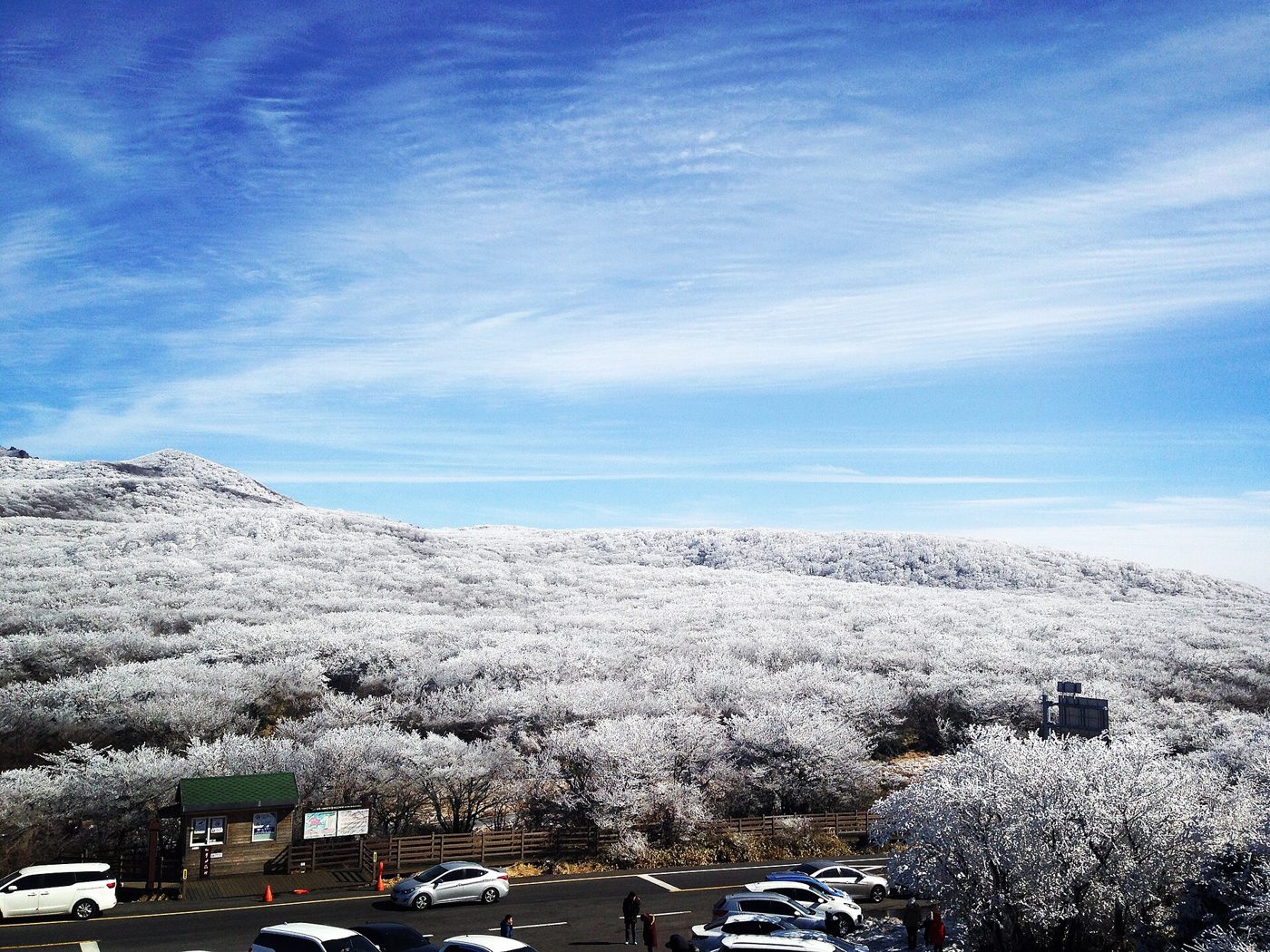
Cover photo: hoarfrost at 1100 Goji, Hallasan, Jeju (February 2017). Photo: Loooys, Wikimedia Commons, CC BY-SA 3.0
From a cable car in Sokcho to a frosted wetland on Jeju
Fares, bus times and booking rules in this guide are as of Saturday, November 21, 2026. Snow is never guaranteed on a given day, but from December to February Korea's high mountains often turn white, and on the coldest mornings the trees grow a coat of rime frost that locals call sanggodae (상고대).
You don't need to be a mountaineer to see it. Two of these stops start with a cable car or gondola, one is a flat forest walk to a temple, one is a gentle loop around a snowy sheep pasture, and one is a roadside deck you can reach on a city bus. We start on the east side of Gangwon Province, swing south to Muju and finish on Jeju.
How We Picked
Every stop here is in a national park or a Korea Tourism Organization (VisitKorea) winter guide, and each one can be reached by public transport. We favoured places where a first-time visitor can see snow without an all-day climb, and we added the booking rules you need to know before you go.
At a glance
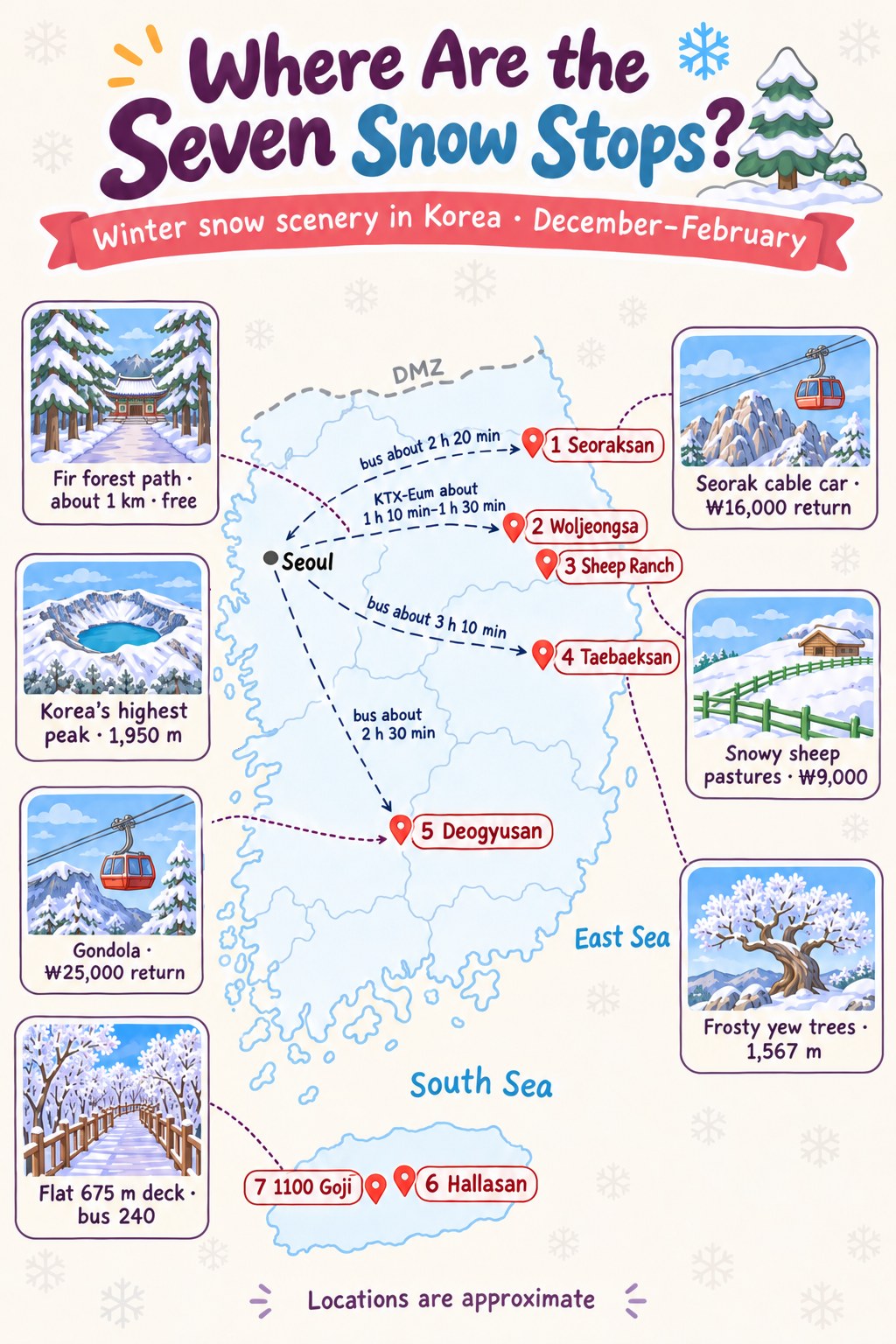
Seven stops: Seoraksan · Woljeongsa Fir Forest Path · Daegwallyeong Sheep Ranch · Taebaeksan · Deogyusan Hyangjeokbong · Hallasan · 1100 Goji
Best months: December–February for snow scenery; it varies from year to year
Easiest: Seorak cable car, Woljeongsa fir forest, Daegwallyeong sheep ranch loop, Deogyusan gondola, 1100 Goji deck
Book ahead: Deogyusan gondola on December–February weekends and holidays; Hallasan summit via Seongpanak or Gwaneumsa
Hours: Deogyusan gondola weekdays up 09:00–16:00 · Seorak cable car hours change daily · Hallasan trail entry closes 11:30–12:00 in winter · Sheep ranch tickets 09:00–16:00 November–February
Fares: Seorak cable car ₩16,000 return · Deogyusan gondola ₩25,000 return · Sheep ranch adult ₩9,000 · entry is free everywhere except the sheep ranch
Gear: Crampons or slip-on traction cleats for any trail; warm layers, gloves and a hat
Last checked: November 21, 2026
In this guide
- How We Picked
- The Seven Stops at a Glance
- When to Go
- The Seven Stops
- Getting There
- Sample Itineraries
- Tips for Visitors
- Sources
The Seven Stops at a Glance
| Stop | What you see | Effort | Fare | Nearest hub |
|---|---|---|---|---|
| Seoraksan | Snowy granite peaks from Gwongeumseong | Cable car + 10-minute climb | Cable car ₩16,000 return | Sokcho |
| Woljeongsa Fir Forest Path | About 1 km of fir trees and a temple under snow | Flat walk | Free | Jinbu (Odaesan) Stn |
| Daegwallyeong Sheep Ranch | Snowy pastures and a wooden hut at about 920 m | 1.2 km loop, about 40 minutes | Adult ₩9,000 | Hoenggye |
| Taebaeksan | Frost-coated yew trees on a high ridge | About 2 hours up | Free entry | Taebaek |
| Deogyusan Hyangjeokbong | Snow flowers on a 1,614 m summit | Gondola + 20-minute walk | Gondola ₩25,000 return | Muju |
| Hallasan | Korea's highest peak, 1,950 m | Half day to full day | Free entry | Jeju City |
| 1100 Goji | Frosted trees around a highland wetland | Short deck walk | Free | Jeju City |
Good to know
Mountain weather changes quickly. Cable cars and gondolas stop in strong wind, and snow can close trails and mountain roads for the day. Keep a spare day if a particular view matters to you.
When to Go
December to February is the window to plan around. Higher peaks catch snow and rime first: rime frost can even appear on Hallasan in late autumn, while the lower forest at Woljeongsa needs a fresh snowfall to look its best. The day after a snowfall, with clear skies, is the classic time to go.
Go early. Gondola and cable car queues build through the morning, the light is best before noon, and several trails stop letting hikers in around midday in winter. Weekdays are quieter, and at Deogyusan they are the only days you can buy gondola tickets on the spot.
The Seven Stops
1. Seoraksan (설악산) — Cable Car to Gwongeumseong
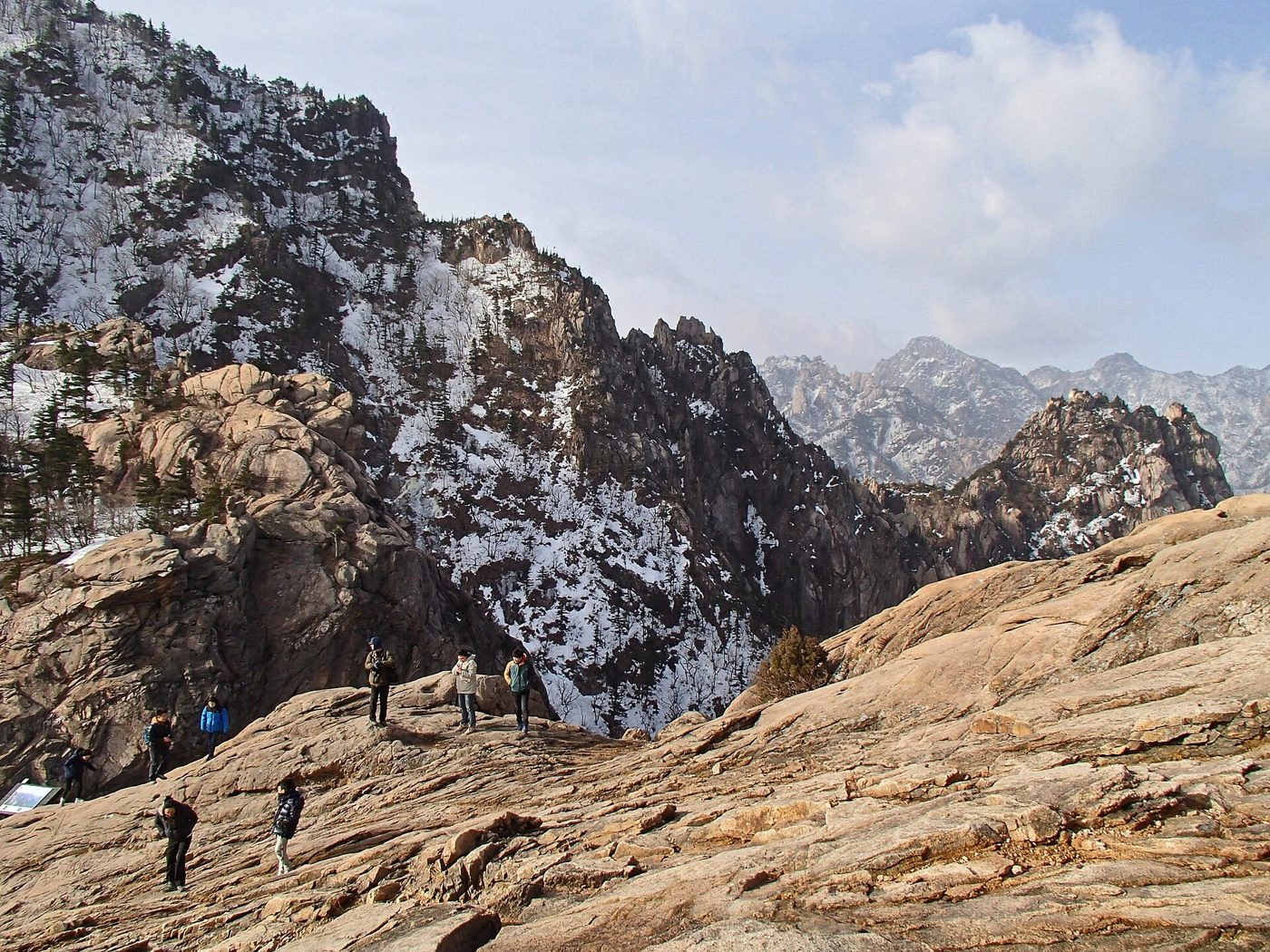
Start on the east coast. From Sokcho, a city bus takes you to Seoraksan Sogongwon, the main park entrance, where the Seorak Cable Car climbs to the ridge of Gwongeumseong in about five minutes. From the upper station, climb the steps on the right for about ten minutes to the granite top, where snowy cliffs drop away on all sides.
The cable car sells return tickets only, on the day, at the station; there is no advance booking. Hours change with the season and the weather and are posted each day, and the cable car stops in strong wind. If the bare granite is icy, enjoy the view from the lower viewpoints instead of scrambling.
Cable car: Adult return ₩16,000 (middle-school age and up); child ₩12,000; under 36 months free. No one-way tickets
Ride: About 5 minutes each way; stops in strong wind or bad weather
Park entry: Free; the Sinheungsa temple fee was dropped in May 2023
Best time: December–February; snow is heavier on the ridges than at the entrance
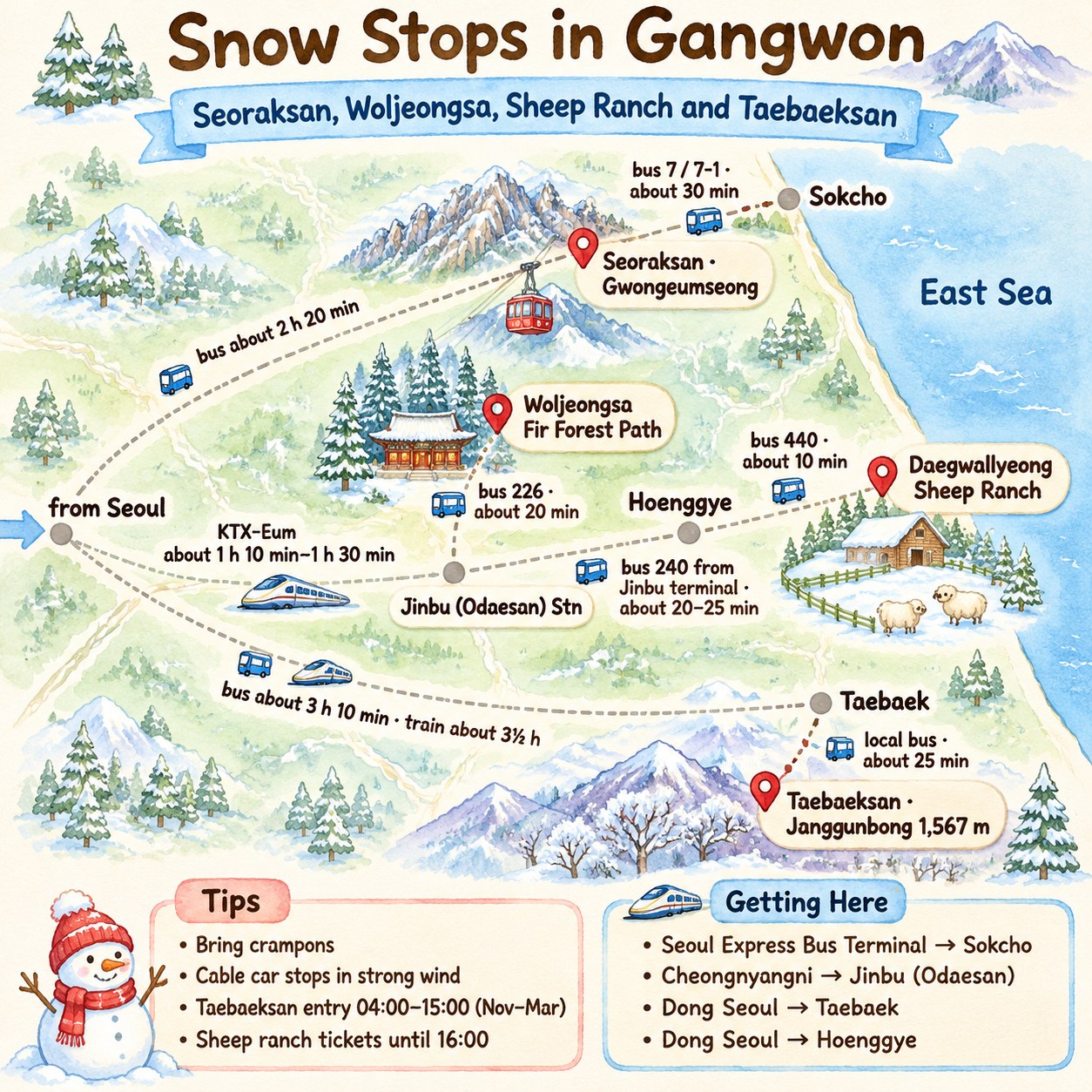
Getting there: Bus 7 or 7-1 from Sokcho to Seoraksan Sogongwon (설악산 소공원), about 30 minutes from central Sokcho; last bus back from Sogongwon 20:35
Trails: High routes such as Daecheongbong have winter entry windows and can close for wildfire prevention or heavy snow
Visitor review (in Portuguese, use your browser's translate): Seoraksan in early January (Experiência Barbara, March 2026)
2. Woljeongsa Fir Forest Path (월정사 전나무숲길) — Odaesan
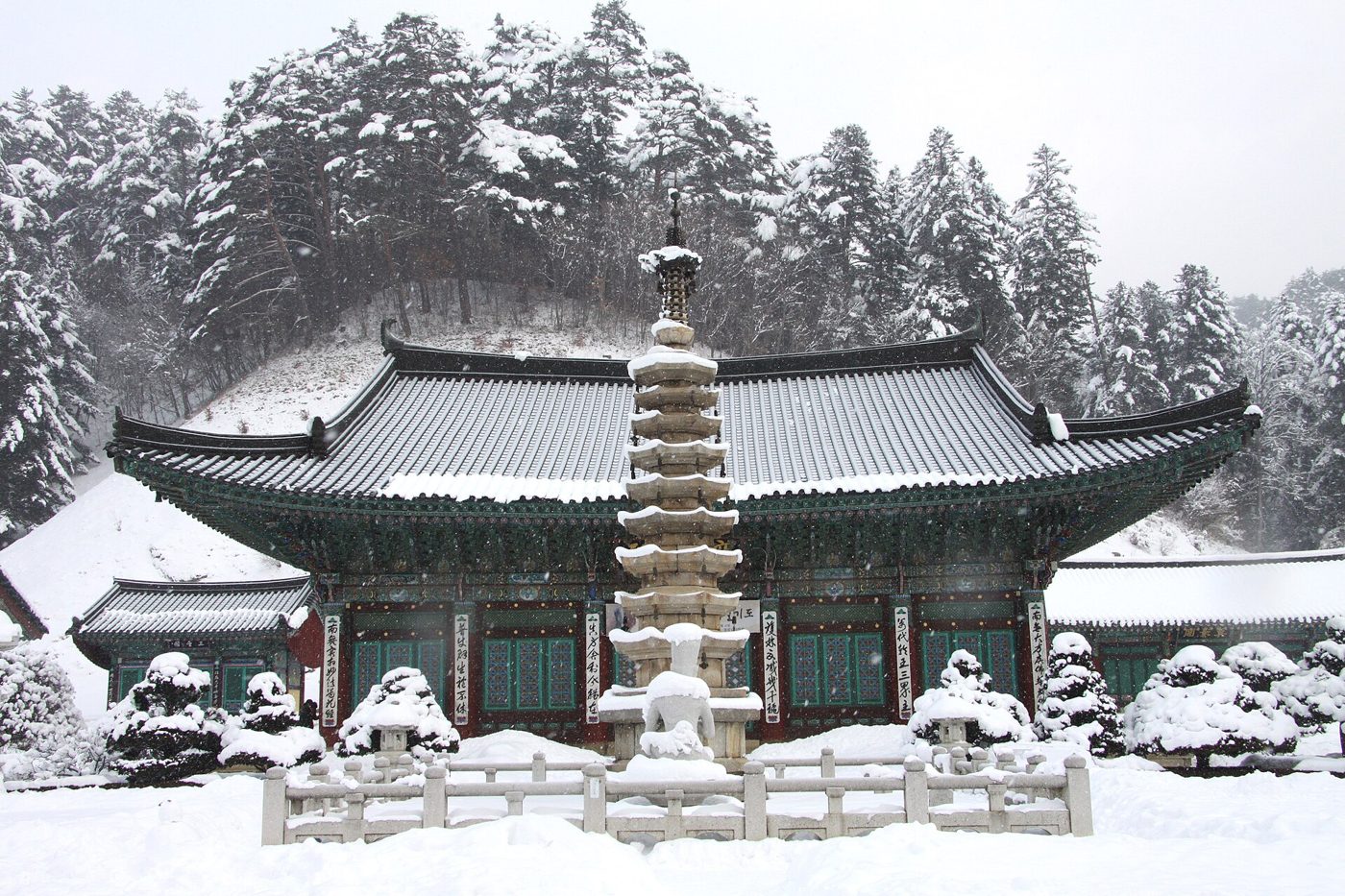
This is the gentlest stop on the list. In Odaesan National Park, a path of about 1 km runs from Woljeongsa's Iljumun gate to Geumganggyo bridge under about 1,700 tall fir trees. After a snowfall the dark green branches carry white, the path is quiet, and it ends at the temple with its octagonal stone pagoda.
It is flat and suits families, but the path can be packed snow or ice, so wear shoes with grip. The KTX makes it an easy day trip from Seoul.
Admission: Free; the temple heritage fee was dropped in May 2023
Length: About 1 km one way, Iljumun gate to Geumganggyo bridge
Best time: December–February, ideally the morning after fresh snow
Getting there: KTX-Eum to Jinbu (Odaesan) Stn, about 1 hour 10 minutes to 1 hour 30 minutes from Cheongnyangni. Take a local bus (for example 224) or a taxi to Jinbu Bus Terminal, then bus 226 to Woljeongsa, about 20 minutes
Bus 226: From Jinbu terminal: first 09:05, last 17:30 (bus 225 also leaves at 07:50). Coming back, bus 226 starts at Sangwonsa and stops at Woljeongsa on the way to Jinbu terminal; the last leaves Sangwonsa at 18:15 and reaches Jinbu at 18:55
Parking: Compact car ₩3,000; mid-size or SUV ₩6,000
Visitor review (in English): A snowy walk to Woljeongsa (Go to Korea; walked in late January, posted October 2026)
3. Daegwallyeong Sheep Ranch (대관령양떼목장) — Snowy Pastures on the Old Pass
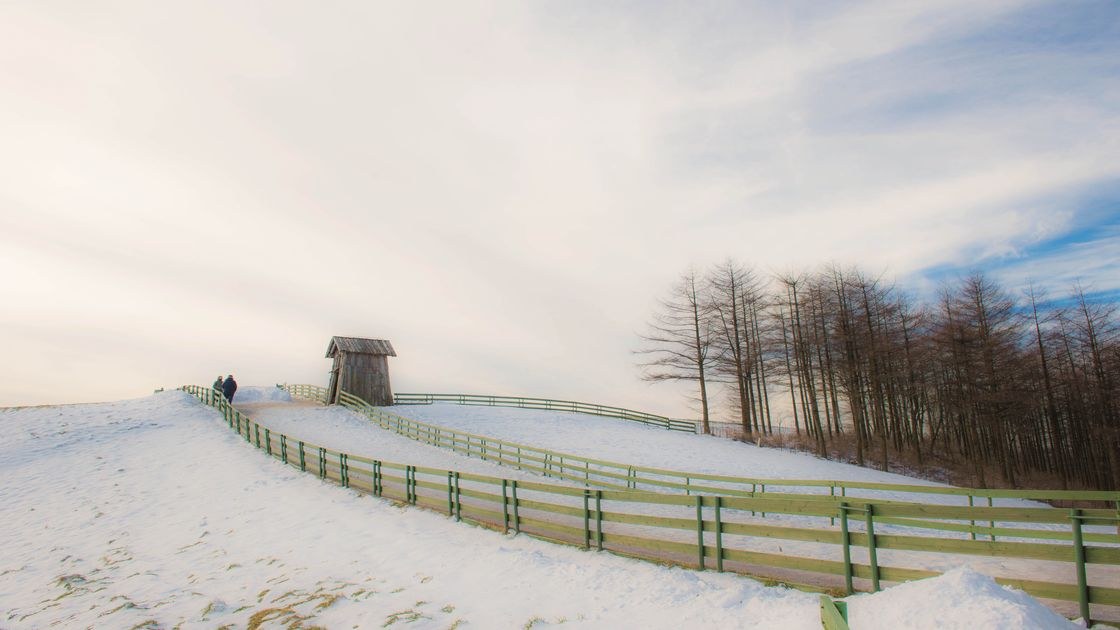
Stay in Pyeongchang for the softest snow scene on the list. On the old Daegwallyeong pass, about 15 km east of Woljeongsa as the crow flies, rolling sheep pastures are fenced with green wooden rails. After a snowfall the hills turn smooth and white, and the small wooden hut on the slope is the photo everyone wants.
A path of about 1.2 km loops around the pasture and climbs to the high point at about 920 m, with a view along the Baekdu-daegan range. It takes about 40 minutes at an easy pace. In winter the sheep stay in the barn rather than on the hill, but you can still see them there and buy a handful of hay to feed them. No reservation is needed.
Admission: Adult ₩9,000; child ₩7,000; seniors and other concessions ₩6,000
Hours: November–February: tickets 09:00–16:00, ranch closes 17:00. Nobody is let in after ticket sales end
Closed: Seollal (Lunar New Year) day and Chuseok day only
Sheep: In 2026 they grazed outdoors until November 15; in winter they stay in the barn, where you can still see them and feed them hay
Best time: December–February, on a clear day after fresh snow
Getting there: Intercity bus from Dong Seoul to Hoenggye (횡계), about 2 hours 30 minutes, with several buses a day. From Jinbu Bus Terminal, bus 240 runs to Hoenggye in about 20–25 minutes. Then county bus 440 from Hoenggye to the ranch, about 10 minutes
Bus 440: From Hoenggye: 08:30, 10:35, 13:30, 16:05. Back from the ranch: about 08:40, 10:45, 13:40, 16:15. The 16:05 bus arrives after ticket sales end, so aim for an earlier one
Address: 483-32 Daegwallyeongmaru-gil, Daegwallyeong-myeon, Pyeongchang (대관령마루길 483-32)
Visitor review (in Korean, use your browser's translate): Daegwallyeong Sheep Ranch in winter (January 2025)
4. Taebaeksan (태백산) — Frost on the Yew Trees
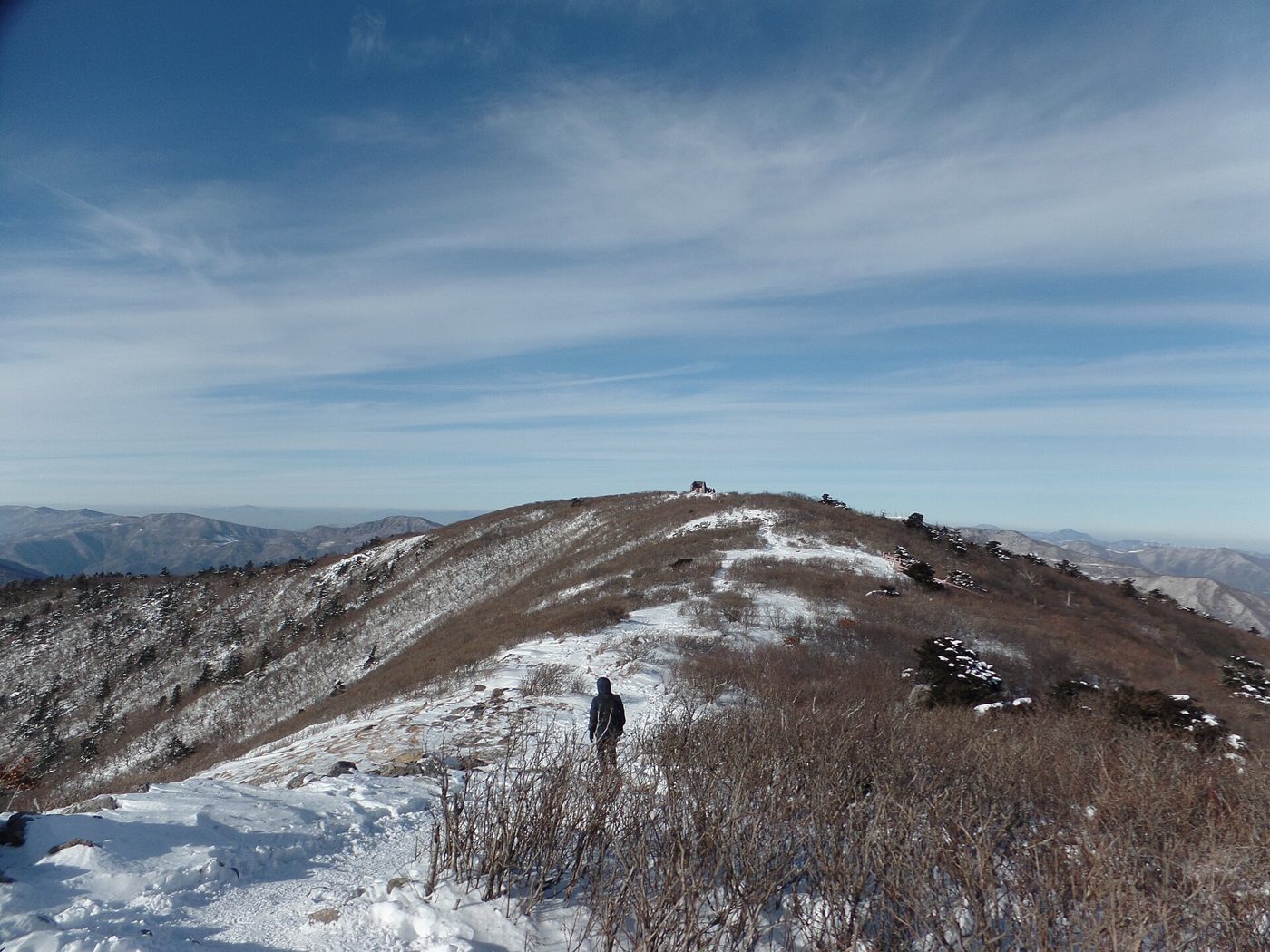
Taebaeksan is the classic winter hike. The highest point, Janggunbong, stands at 1,567 m, and the ridge around it is known for old yew trees that turn white with rime frost and snow. The broad ridge is a steady climb rather than a scramble, so it is a good first winter hike if you bring crampons.
You can go up from Yuilsa and come down to Danggol, where the Taebaeksan Snow Festival sets up its snow sculptures each winter. The 2026 festival ran from January 31 to February 8 at Danggol Plaza; it usually falls between late January and early February.
Admission: Free
Routes: Yuilsa entrance → Janggunbong → Cheonjedan, 4 km, about 2 hours one way. Danggol Plaza → Banjae → Manggyeongsa → Cheonjedan, 4.4 km, about 2 hours one way
Entry hours: November–March, trail entry 04:00–15:00 at Danggol, Baekdansa and Yuilsa
Best time: January–February for snow and rime; it varies from year to year
Getting there: Bus from Dong Seoul Bus Terminal to Taebaek, about 3 hours 10 minutes; or train from Cheongnyangni to Taebaek, about 3½ hours (a few trains a day). From Taebaek terminal, local buses reach Yuilsa in about 23 minutes and Danggol in about 25 minutes
Gear: Crampons and full winter clothing; the ridge is exposed to wind
Visitor review (in Korean, use your browser's translate): Taebaeksan from Yuilsa in snow (아키텍트류, January 2025)
5. Deogyusan Hyangjeokbong (덕유산 향적봉) — Gondola to the Snow Flowers
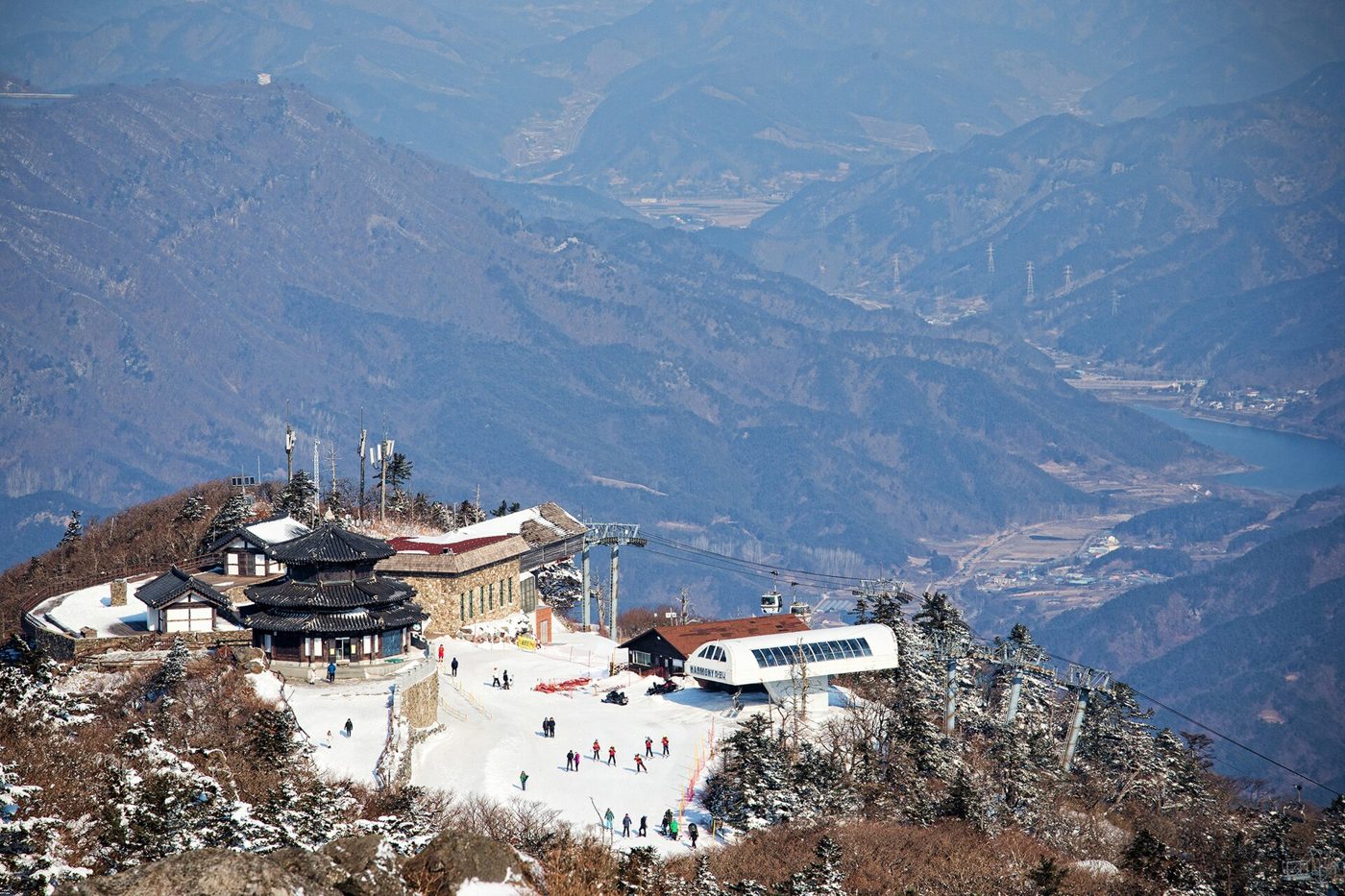
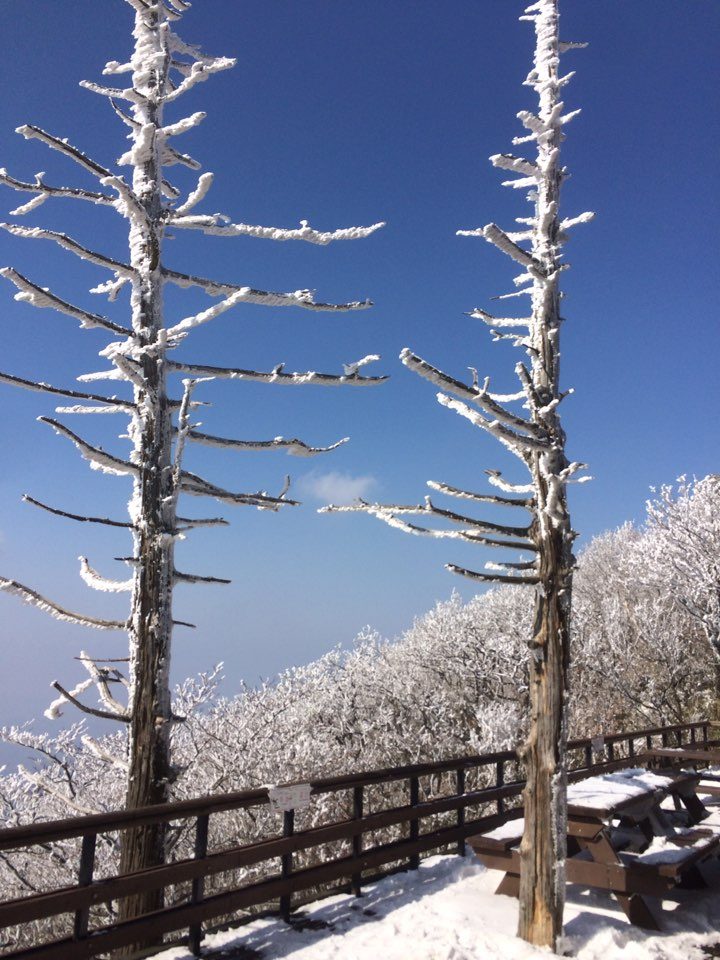
Head south to Muju for the easiest way onto a high snowy summit. The tourist gondola at Muju Deogyusan Resort rises about 15 minutes to Seolcheonbong (1,522 m). From there, a path of about 20 minutes leads to Hyangjeokbong, the 1,614 m top of Deogyusan, through trees crusted with snow flowers on cold days.
Plan this one ahead. From December to February, gondola seats on weekends and public holidays are sold by reservation only, through the resort website, from 17:00 two weeks before your date. On weekdays you buy tickets at the counter. With a reservation, pick up your tickets at the gondola ticket office from 30 minutes before your slot; if you have not collected them by the end of your slot, the booking is cancelled automatically.
Gondola: Adult return ₩25,000; one way ₩20,000. Child return ₩20,000
Hours: Winter season from December 13: Monday–Friday, up 09:00–16:00, last ride down 16:30. Weekend times follow the reservation slots
Reservations: December–February weekends and holidays: reservation only (up to 5 people per booking); weekdays: buy at the counter
Best time: December–February
Getting there: Bus from Seoul Nambu Terminal to Muju, about 2 hours 30 minutes. From the Muju Tourist Information Center car park (P1), the resort's free shuttle leaves at 05:00, 07:20, 10:30 and 16:30 (arriving 05:55, 08:20, 11:25 and 17:00); it runs back at 09:30, 15:30, 18:30 and 21:10. One direct bus a day from Seoul Nambu also stops at Muju Resort (a morning departure; check the time when you book), and the return bus leaves the resort stop at 13:55
Note: The shuttle is a 15-seat minibus and can fill up; the summit path can close after heavy snow
6. Hallasan (한라산) — Jeju's Snow-Capped Volcano
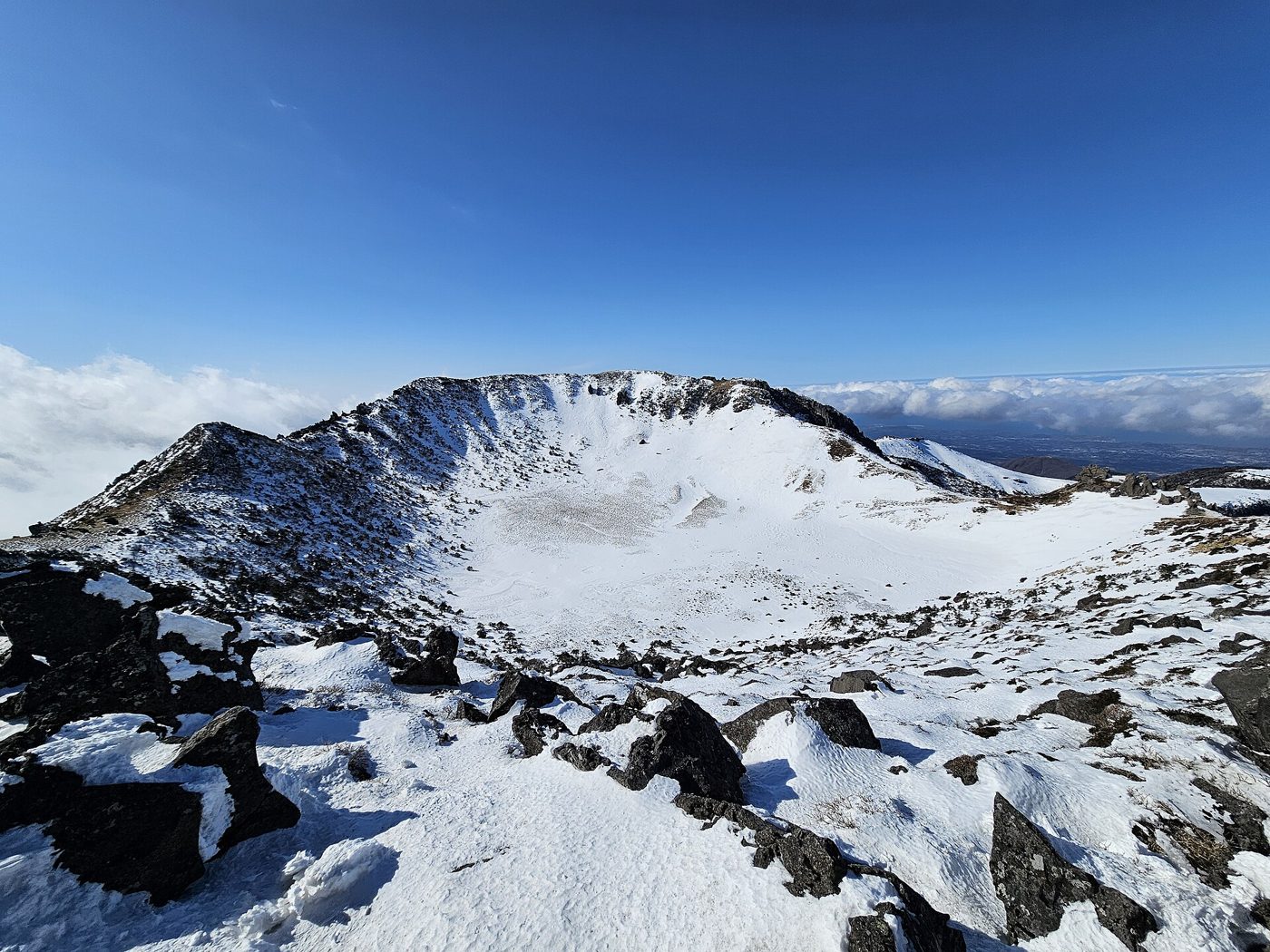
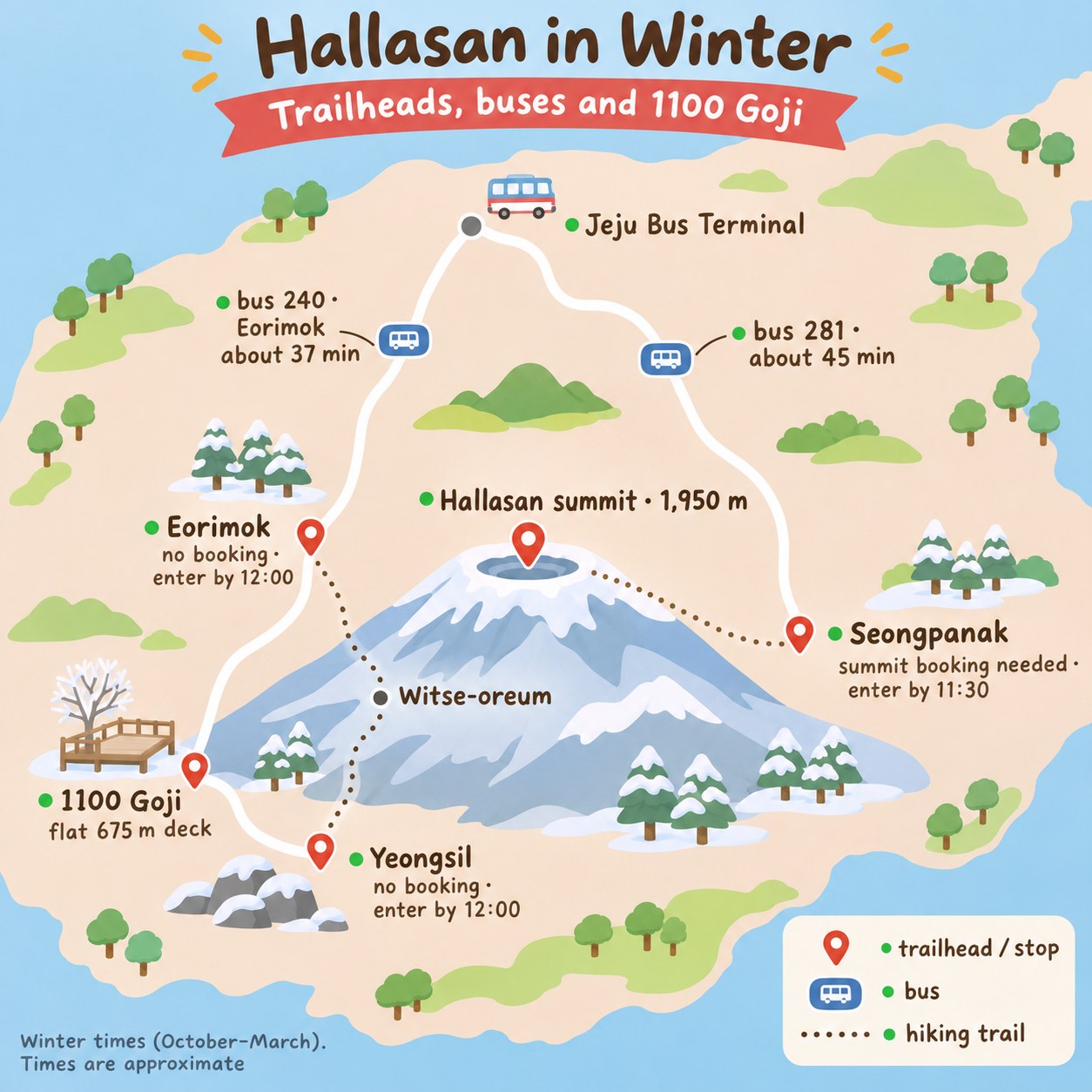
Fly to Jeju to finish on Korea's highest mountain, 1,950 m. You have two ways to see it in snow. Eorimok and Yeongsil need no booking and climb to Witse-oreum, a wide snowy plateau below the summit wall. To stand on the summit at Baengnokdam crater, take Seongpanak or Gwaneumsa, which need a free advance reservation for the summit section.
Book the summit on the Hallasan reservation website: each month's slots open at 09:00 on the first working day of the month before, with up to four people per booking and normal daily limits of 1,000 on Seongpanak and 500 on Gwaneumsa. Bring the QR code and your passport. Winter cut-off times are strict, so start early.
| Trail | Booking | Winter entry closes (October–March) |
|---|---|---|
| Eorimok | Not needed | Trail control 12:00; Witse-oreum toward the south wall 13:00 |
| Yeongsil | Not needed | Trail control 12:00; Witse-oreum toward the south wall 13:00 |
| Seongpanak (summit) | Required | Entrance and Jindallaebat checkpoint 11:30 |
| Gwaneumsa (summit) | Required | Entrance and Samgakbong checkpoint 11:30 |
Admission: Free. Trailhead parking for small cars ₩1,000 for the first hour, then ₩500 per 20 minutes (daily maximum ₩13,000); mid-size and large vehicles ₩2,000, then ₩800 (maximum ₩20,000)
Best time: December–February
Getting there: Bus 281 from Jeju Bus Terminal to Seongpanak, about 45 minutes, roughly every 10–20 minutes (bus 181 from Jeju Airport, about 35 minutes). Bus 240 from Jeju Bus Terminal to Eorimok (about 37 minutes) and Yeongsil (about 52 minutes), roughly every 50–90 minutes, with fewer buses November–March
Gear: Crampons are recommended from December 1 to March 31, and staff check gear at trail entrances
Snow days: When 1100 Road or 5.16 Road closes for snow, buses 240 and 281 take other roads and skip the mountain stops
Visitor review (in Korean, use your browser's translate): Easy winter hiking from Eorimok (히도리, January 2026)
7. 1100 Goji (1100고지) — Frost Without the Hike
If you only have a morning on Jeju, or you do not want to hike, ride bus 240 up 1100 Road to the 1100 Goji rest area. At 1,100 m, the highland wetland here is often frosted and snowy in winter, as in the cover photo of this guide. A 675 m wooden deck circles the wetland with no climbs at all.
The deck can be icy, so walk slowly. When snow closes 1100 Road, buses skip the stop, so check the road status on the morning you go.
Admission: Free
Walk: 675 m wooden deck loop, flat
Best time: December–February, on a clear morning after snow or frost
Getting there: Bus 240 from Jeju Bus Terminal to 1100 Goji Rest Area (1100고지휴게소), between the Eorimok and Yeongsil stops; roughly every 50–90 minutes, fewer November–March
Getting There
| Stop | From | Main ride | Last leg |
|---|---|---|---|
| Seoraksan | Seoul Express Bus Terminal or Dong Seoul | Bus to Sokcho, about 2 h 20 min | Bus 7 / 7-1 to Seoraksan Sogongwon, about 30 min |
| Woljeongsa | Cheongnyangni or Seoul Stn | KTX-Eum to Jinbu (Odaesan), about 1 h 10 min–1 h 30 min from Cheongnyangni (1 h 30 min–1 h 50 min from Seoul Stn) | Bus 226 from Jinbu terminal, about 20 min |
| Sheep Ranch | Dong Seoul | Bus to Hoenggye, about 2 h 30 min | Bus 440 to the ranch, about 10 min |
| Taebaeksan | Dong Seoul or Cheongnyangni | Bus about 3 h 10 min; train about 3½ h | Local bus to Yuilsa about 23 min, Danggol about 25 min |
| Deogyusan | Seoul Nambu Terminal | Bus to Muju, about 2 h 30 min | Free resort shuttle from Muju (05:00, 07:20, 10:30, 16:30) |
| Hallasan | Jeju Bus Terminal | Bus 281 (Seongpanak) or 240 (Eorimok, Yeongsil) | — |
| 1100 Goji | Jeju Bus Terminal | Bus 240 | — |
Sample Itineraries
A snowy day trip from Seoul: Woljeongsa
Take a morning KTX-Eum to Jinbu (Odaesan), transfer to Jinbu Bus Terminal and catch bus 226 (first 09:05) to Woljeongsa. Walk the fir forest to the temple, have lunch, and take bus 226 back to Jinbu for a train to Seoul.
| Time | What to do |
|---|---|
| 09:05 | Bus 226 from Jinbu Bus Terminal to Woljeongsa, about 20 minutes. Take an early KTX-Eum to Jinbu (Odaesan) Stn first; local bus 224 leaves the station at 08:55 and reaches the terminal at 09:00. |
| 09:30 | Walk the Fir Forest Path from the Iljumun gate, about 1 km on the flat. |
| 10:30 | Woljeongsa: the temple courtyard and the octagonal stone pagoda in the snow. |
| 12:00 | Head back: bus 226 leaves Sangwonsa at 11:45, stops at Woljeongsa and reaches Jinbu Bus Terminal at 12:25. Later buses run through the afternoon; the last leaves Sangwonsa at 18:15. |
An overnight in Sokcho: Seoraksan
Ride the bus from Seoul to Sokcho in the morning, take bus 7 or 7-1 to Seoraksan Sogongwon and go up the cable car while the light is good. Spend the night in Sokcho and walk the beach before heading back the next day.
A winter weekend in Taebaek
Arrive in Taebaek by bus or train the evening before. Start up from Yuilsa early, cross the frosty ridge and come down to Danggol. If you visit during the snow festival, finish among the snow sculptures at Danggol Plaza.
Two snowy days on Jeju
Day 1: bus 240 to Eorimok, walk up to Witse-oreum (enter before 12:00), then take bus 240 one stop further south to 1100 Goji and catch a northbound 240 from there back to Jeju City. Day 2: with a reservation, take bus 281 to Seongpanak and start early to pass the Jindallaebat checkpoint before 11:30 on your way to the summit.
Tips for Visitors
- Crampons: Bring slip-on crampons or traction cleats for every trail stop. Hallasan staff check gear at trail entrances from December 1.
- Start early: Winter cut-off times on Hallasan (11:30–12:00) and short daylight mean morning starts.
- Book Deogyusan: For December–February weekends and holidays, reserve the gondola on the resort website two weeks ahead, from 17:00.
- Book Hallasan: Summit reservations for Seongpanak and Gwaneumsa open at 09:00 on the first working day of the previous month. Carry your passport with the QR code.
- Wind: Cable cars and gondolas stop in strong wind. Have a backup plan, such as the Woljeongsa fir forest or the 1100 Goji deck.
- Road closures: Heavy snow can close mountain roads, and buses then skip mountain stops. Check before you set out.
- Layers: Summits are far colder and windier than the cities below. Bring gloves, a hat and a warm, windproof outer layer.
Tip
Snow scenery is best on the first clear day after a snowfall. Watch the forecast for the region you plan to visit and keep your plans flexible by a day if you can.
Sources
- Winter season: VisitKorea: winter mountains
- Seoraksan: Seorak Cable Car: fares and guide · Seorak Cable Car: sights at the top · Sokcho City: city buses · Sokcho bus timetable · Korea National Park Service: trail entry hours · Gangwon Ilbo: temple fee waiver, May 2023
- Woljeongsa: Pyeongchang County: Woljeongsa Fir Forest Path · VisitKorea: Woljeongsa Temple & Needle Fir Forest · Yonhap: heritage fee waiver, May 2023 · Pyeongchang bus timetable · Pyeongchang County bus: Woljeongsa route
- Daegwallyeong Sheep Ranch: Daegwallyeong Sheep Ranch: fees and ticket hours · Daegwallyeong Sheep Ranch: 2026 grazing end date notice · VisitKorea: Daegwallyeong Sheep Ranch · Rural Development Administration webzine, February 2026 · Pyeongchang bus timetable (buses 240 and 440) · VisitKorea: buses to Hoenggye
- Taebaeksan: Korea National Park Service: Taebaeksan map · Korea National Park Service: entry hours · Taebaek City: 2026 tourist map · Taebaek City: transport · Taebaek City: local buses · Taebaek City: trains to Taebaek (January 2026) · Taebaeksan Snow Festival
- Deogyusan: Muju Deogyusan Resort: gondola reservations and fares · Muju Deogyusan Resort: gondola hours · Muju Deogyusan Resort: shuttle bus · Muju Deogyusan Resort: directions · Muju County: intercity buses · Jeonbuk tourism: Deogyusan in winter
- Hallasan and 1100 Goji: Hallasan National Park: trail hours · Hallasan National Park: reservation notice · Hallasan National Park: fees and parking · Hallasan National Park: bus access · News1: winter crampon checks, November 18, 2026 · Jeju bus 240 timetable (from Jeju Bus Terminal) · Jeju bus 240 timetable (to Jeju Bus Terminal) · Visit Jeju: 1100 Goji wetland · VisitKorea: Hallasan
- Photos: Cover, 1100 Goji hoarfrost — Loooys (CC BY-SA 3.0) · Gwongeumseong — Lcarrion88 (CC BY-SA 4.0) · Woljeongsa — Leejiwoong35 (CC BY-SA 4.0) · Daegwallyeong Sheep Ranch — 최경이 (Gongu Madang, donated work, free use) · Taebaeksan — Jyuri08 (CC BY-SA 3.0) · Seolcheonbong — Mg shin (CC BY-SA 4.0) · Deogyusan snow trees — Marcella Astrid (CC BY-SA 3.0) · Baengnokdam — Sadopaul (CC BY 4.0)


Last checked: November 21, 2026