Travel Tips
How to Ride a Bus in Seoul: A Simple Step-by-Step Guide for Visitors
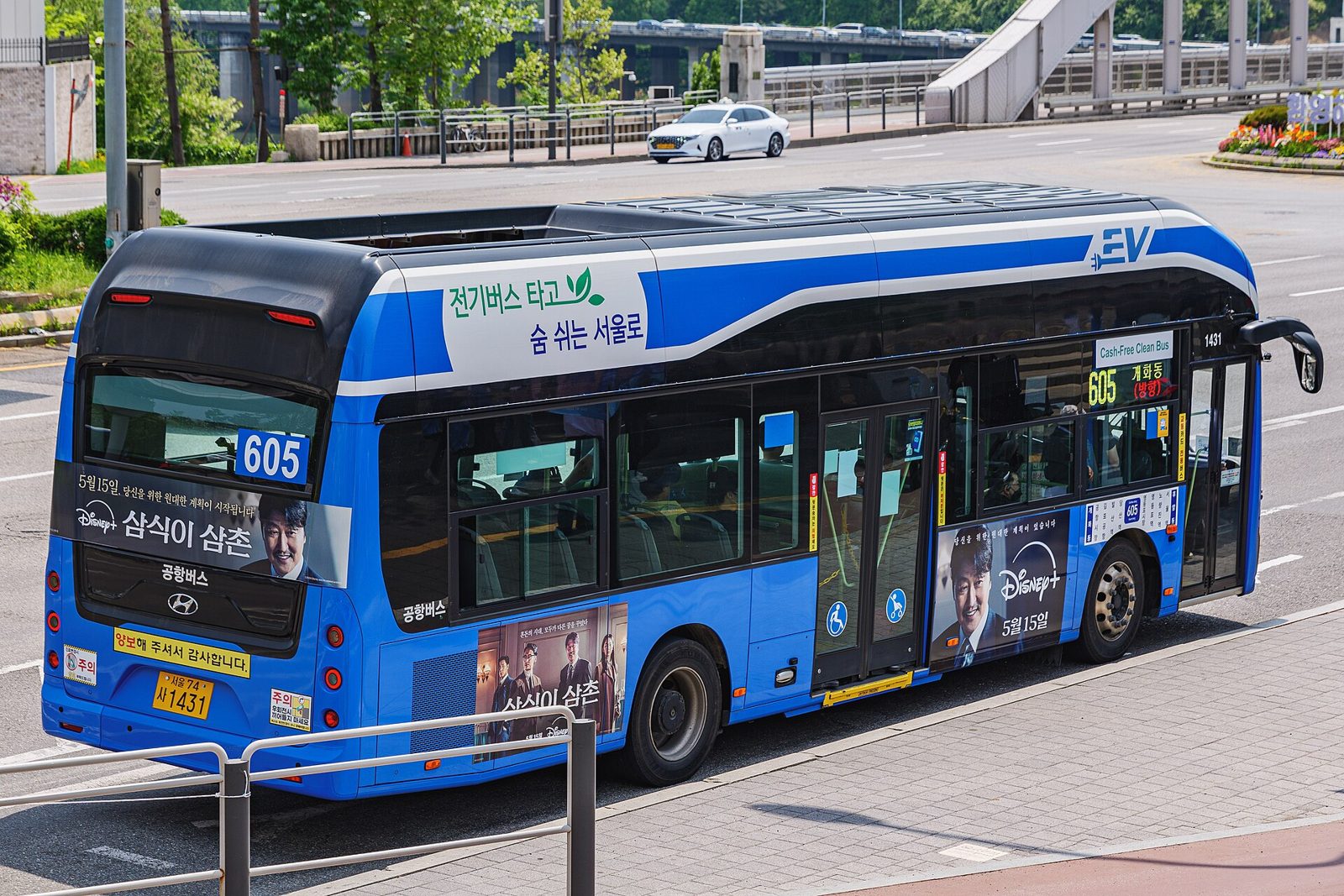
Top photo: a blue route 605 bus on Nodeulseom Island, May 2024. Photo: TurnOnTheNight, Wikimedia Commons, CC BY-SA 4.0

Seoul's buses go places the subway doesn't, and you see the city on the way. They look complicated at first because the signs are mostly in Korean, but a ride is always the same few steps. Here they are, in order.
The one thing to know: tap your card when you get off, not just when you get on. That second tap is what makes your next bus or subway ride cheap.
At a glance
Adult fare: blue and green buses ₩1,500 · yellow ₩1,400 · village buses ₩1,200 · red buses ₩3,000 · night buses ₩2,500
Pay with: a T-money card (or a Climate Card short-term pass). Some routes take no cash at all
Doors: on at the front, off at the middle or back. Tap your card both times
Transfers: tap on the next bus or subway within 30 minutes (60 minutes between 21:00 and 07:00)
Apps: Naver Map or KakaoMap for routes and live arrival times
Last checked: October 15, 2026
Step by step
1. Get a transit card first
Buy a T-money card at a convenience store or a subway station and load some money onto it. The card works on buses, the subway and taxis. A single-journey subway ticket won't work on a bus (Seoul city).
If you'll ride a lot, a Climate Card short-term pass (1, 2, 3, 5 or 7 days, from ₩5,000) gives unlimited rides. Since October 1, 2026 it covers only buses licensed by Seoul: blue, green, yellow, village and night buses. Red wide-area buses, airport buses and buses licensed by other cities (for example Gyeonggi buses that come into Seoul) are not covered. A Seoul-licensed bus still works if you get on or off outside the city (Seoul city).
2. Find the stop and read the sign
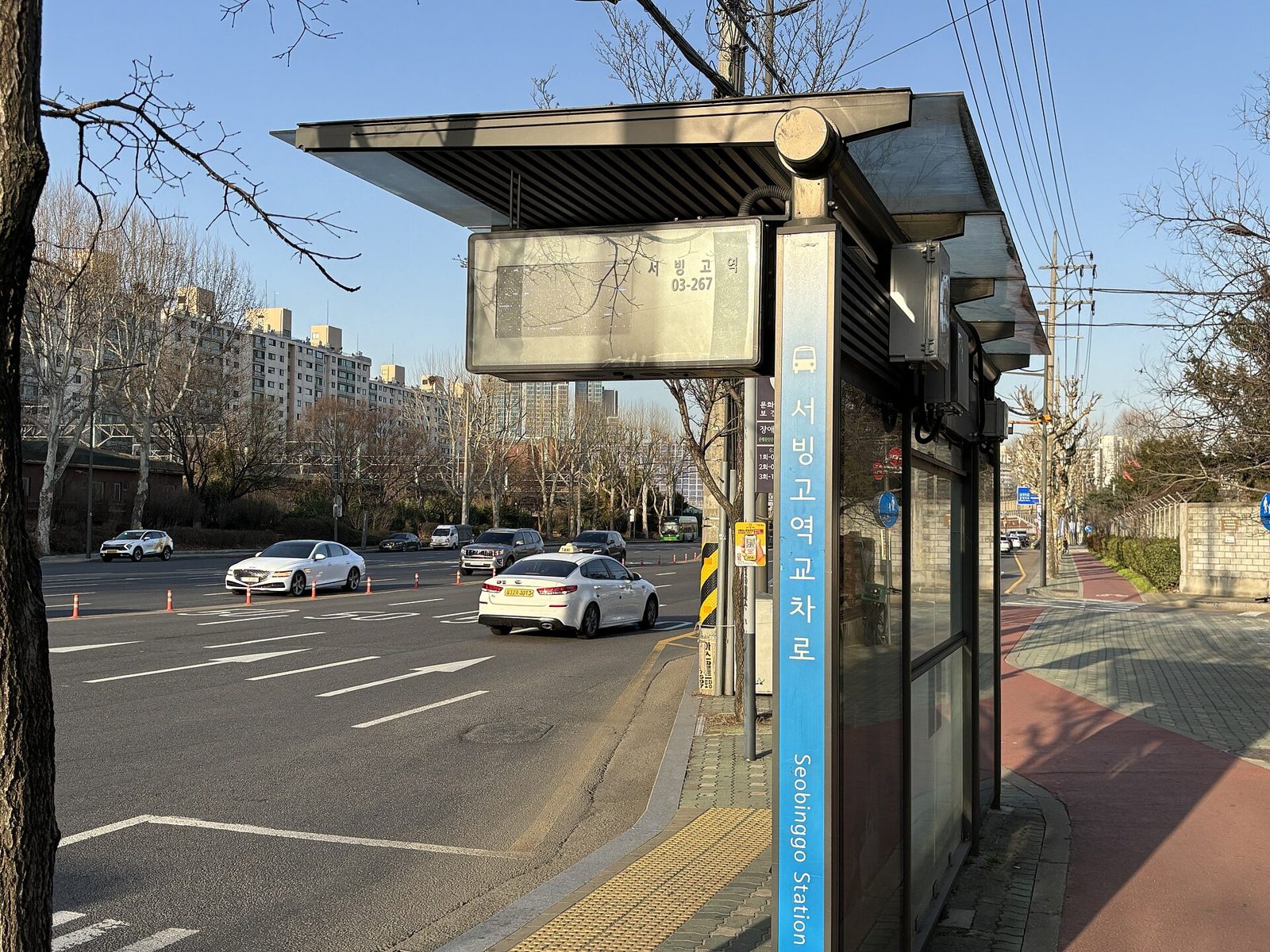
Your map app tells you which stop to go to. At the stop, look for three things:
- The stop number. Seoul stops have a five-digit number on the sign. Type it into an app to be sure you're at the right stop, and on the right side of the road (Seoul bus API).
- The route list. The sign lists every bus that stops there. Check that yours is on it.
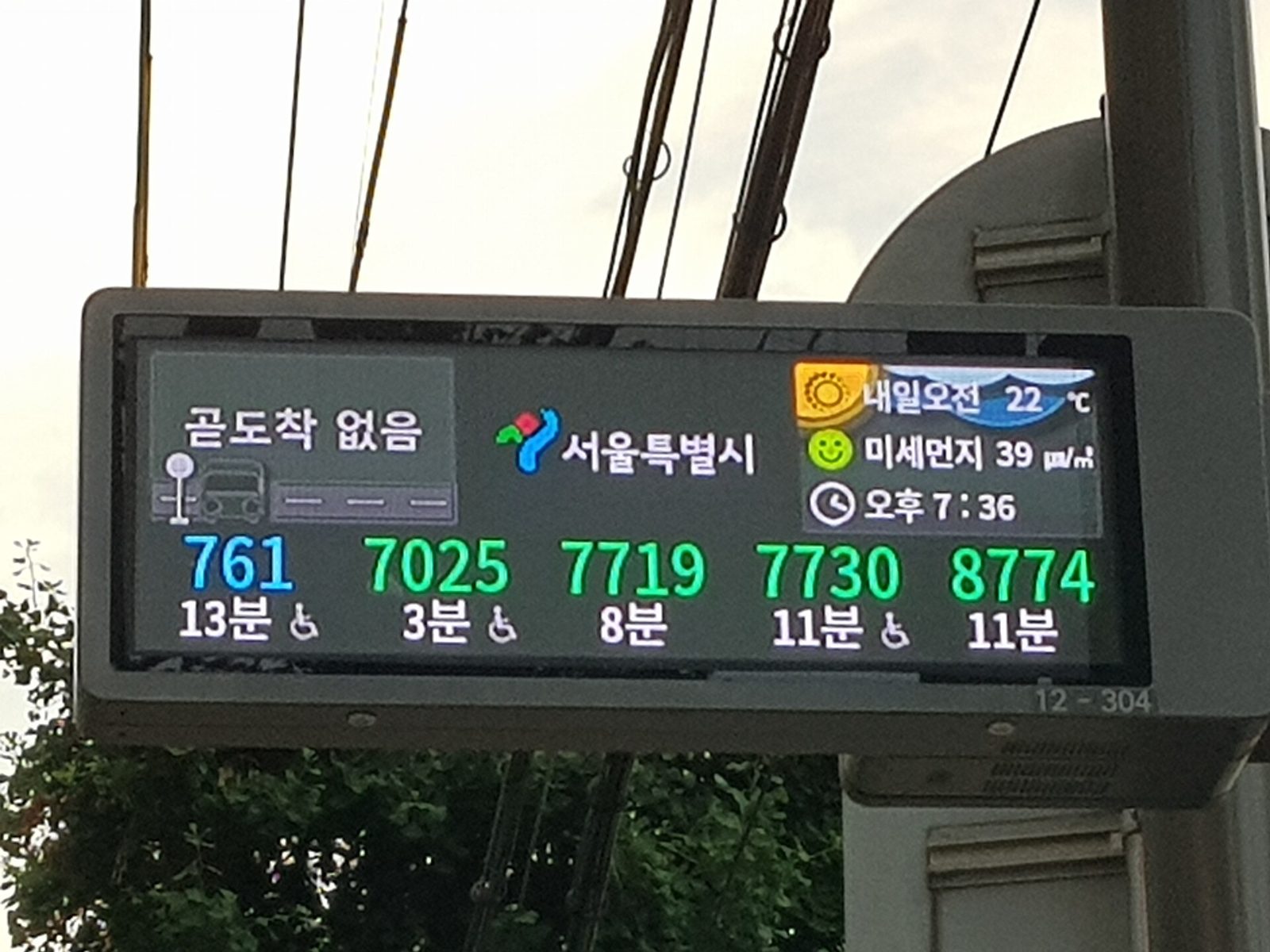
- The arrival screen. Most busy stops have a screen showing each route number and how many minutes until it arrives. The same live data is in Naver Map, KakaoMap and on the Seoul TOPIS site (Seoul city).
3. Know the bus colors
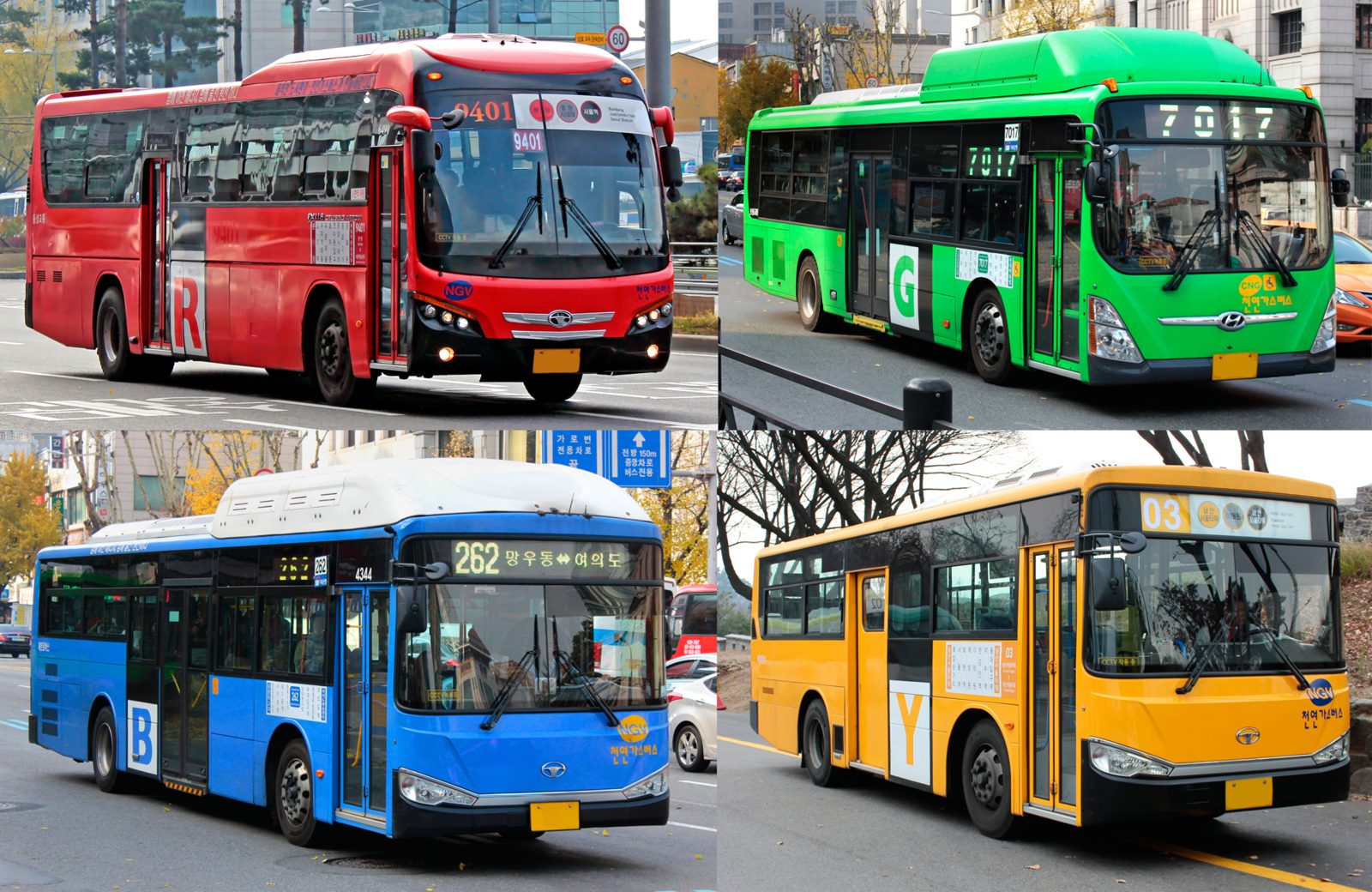
- Blue (trunk): long routes along main roads, linking different parts of Seoul. ₩1,500.
- Green (branch): shorter routes linking neighborhoods to subway stations and blue buses. ₩1,500.
- Yellow (circulation): loops around central Seoul and the business districts. ₩1,400.
- Red (rapid / wide-area): express buses between Seoul and the surrounding cities. ₩3,000.
- Village buses (마을버스): small green buses on short routes into residential streets that bigger buses can't reach. ₩1,200.
Fares are for adults paying by card. Before 6:30 a.m. your first ride is 20% cheaper by card, except on night buses (Seoul city; VisitSeoul; Seoul fares).
4. Check the route number and the direction
Seoul buses carry a two- to four-digit number, set by where the route starts and ends (Seoul city). The number is shown on the front and side of the bus and on the arrival screen.
The same route stops on both sides of the road, going opposite ways. Before you wait, check in your app that the next stop listed is the one toward your destination. This is the mistake most people make once.
5. Board at the front and tap your card
Wave so the driver sees you, then get on through the front door. Tap your card on the reader next to the driver. A beep means you've paid. Paying for friends on one card? Tell the driver, or hold up fingers, before you tap. The group then has to transfer together, the same number of people each time, and a shared card gets no transfer discount onto the subway. One card each is simpler (Seoul city; Seoul city fares).
6. Don't count on cash
Cash costs the same as a card, but it's being phased out. Seoul's list from January 2026 names 183 cash-free routes, a mix of blue, green and other buses, and a bus with no fare box can't take your notes (Seoul city). Carry a loaded card and it won't matter.
7. Press the stop button
A screen and announcements tell you the next stop. Major stops are usually announced in English as well as Korean, but don't expect English at every small stop (VisitSeoul). When yours is next, press one of the red stop buttons on the poles or walls. Press it before the bus reaches the stop, not as it pulls in (Seoul city).
8. Exit at the middle or back door and tap again
Get off through the back door and tap your card on the reader beside it on the way out. Move toward the door before the stop so the driver knows someone is getting off.
On a Climate Card short-term pass there's no penalty for a missed tap-off, but tap anyway: it's a good habit, and on T-money it's what gets you the transfer discount (Climate Card FAQ).
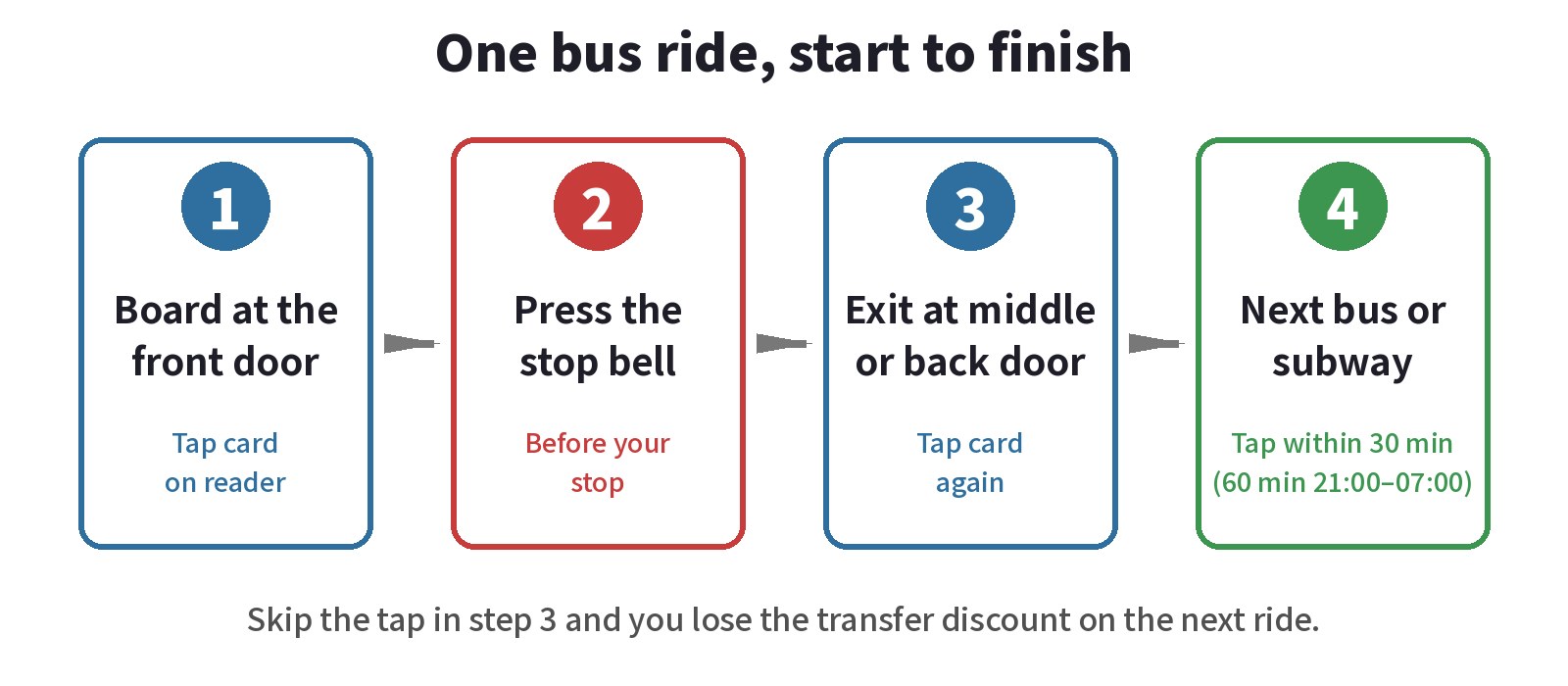
9. Transfer within 30 minutes
If you tapped off, your next ride (bus or subway) counts as a transfer when you tap on within 30 minutes, or within 60 minutes between 21:00 and 07:00. You can transfer up to four times, five rides in total. You pay the higher base fare of the modes you used, plus ₩100 for every 5 km once the whole trip passes 10 km. Trips that include a red wide-area bus get a 30 km base distance instead. Getting back on the same route doesn't count as a transfer (Seoul city; Seoul fares; Seoul transfer discount).
10. Late at night: the "N" buses
Seoul runs 14 night-only bus routes with numbers that start with N (N13, N26, N61 and so on). The network runs overnight, roughly 23:00 to 06:00, but first and last departures vary by route (N26, for example, leaves its terminal from 00:00 to 03:25). The fare is ₩2,500 by card. They run less often than day buses, so check the route's times and the next arrival in your app before you head to the stop (Seoul city).
11. Use an app
- Naver Map and KakaoMap: search a place, pick the bus route, and you get the stop, the route number, live arrival times and where to get off. Both show the live Seoul bus data (Seoul city).
- KakaoBus: a bus-only app for live arrivals at your saved stops.
- No app? The Seoul bus site, bus.go.kr, shows routes and arrivals in a browser.
Searching in Korean (or copying the Korean name of a place) usually finds it faster than English.
Bus etiquette
- Hold on. Drivers move off quickly once the doors close.
- Leave the priority seats for older people, pregnant women and passengers with disabilities.
- Take off your backpack on a crowded bus and keep phone calls short and quiet.
- Let people off before you push toward the door.
Common mistakes
- Forgetting to tap off. On T-money you lose the transfer discount on your next ride.
- Waiting on the wrong side of the road. Check the next stop in your app.
- Holding out cash on a cash-free route.
- Taking a red bus on a Climate Card pass. Red wide-area and airport buses aren't covered.
- Pressing the bell too late. Press it as soon as your stop is announced as next.
Sources
- Seoul Metropolitan Government: Public Transportation (how to ride a bus)
- Seoul Metropolitan Government: Modes of Transport (bus types, fares, transfer rules)
- Seoul city: 교통 요금 안내 (fares and early-morning discount)
- Seoul city: 현금 없는 버스 운영 노선번호 안내 (January 2026)
- Seoul city: 기후동행카드 단기권 소개 (Climate Card short-term pass, coverage from October 1, 2026)
- Seoul city: 심야 전용 시내버스 (올빼미버스) 운행
- Seoul city: 통합환승 할인제도 (transfer discount, 30 km base for wide-area buses)
- Seoul city: 기후동행카드 단기권 FAQ (no missed tap-off penalty, Q88)
- VisitSeoul: Bus and VisitSeoul: Bus essentials
- Seoul bus information API: stop number (ARS ID)
- Seoul TOPIS
Photos from Wikimedia Commons under the licenses shown in each caption. Fares and rules change; check the official pages above before you travel.